Showing posts with label autism epidemic. Show all posts

Friday, April 19, 2013

Autism Rising? Not According to Behavior Analyst Steve Taylor Who Proclaims That Autism Is 100% Genetic In Origin


Since my son was diagnosed with Autistic Disorder in 1998 the rates of diagnosed autism have risen dramatically from 1 in 500 to the current estimated rate of 1 in 88.  There is common acknowledgement that a substantial increase resulted from the DSM-IV changes which pushed acceptance of Aspergers as part of an autism spectrum.  Social factors such as increased awareness and availability of services under an autism label have also been cited.  Some purported autism experts  though have concluded that the dramatic autism increases are entirely attributable to diagnostic changes, increased awareness and the desirability for service reasons of an autism diagnosis. One such  autism expert is Behavior Analyst Steve Taylor who proclaims  in the Modesto Bee that "Autism isn't spreading, but the diagnosis is"

The dramatic increases have also taken place during years when genetic autism research received an overwhelming share of the autism research dollar. Calls for increased funding for environmental autism research by respected researchers like Hertz-Picciotto, Pessah, Landrigan, Birnbaum and others have not  tilted the balance dramatically away from the "its gotta be genetic mindset".  No study proving that the overwhelming increase in autism disorders is caused entirely by diagnostic change and increased social awareness has been produced.  No study producing a genetic explanation for all or even a significant number of autism disorders has been produced.  Very few environmental autism studies have been funded compared to genetic studies and yet the Steve Taylors of the expert autism community claim that there is no real increase at all.  

As they did with the refrigerator mothers theory of autism a few decades ago many of the world's autism "experts" embrace as an article of faith that autism isn't increasing.  Once again too the finger is pointed, at least in part, at parents ..... this time it is parents seeking services for their children as stated by Taylor in the  Modesto Bee:

"I'm still working with the same kind of kids, but everyone today seems to have autism. I met an area family for the first time recently and the 3-year-old I was there to help looked me in the eye and told me, "Go home." He's got autism, now.
No one can diagnose a complex disorder from a single interaction, but I'm going to spend months and maybe years working with this family to change behaviors that this rude boy would likely grow out of and, despite my best efforts, maybe make it worse.
For pure and understandable motives, parents still lobby for the diagnosis. An autism diagnosis brings more services.
The Stanislaus County Office of Education lists three pre-formal diagnostic (too young to diagnose) intensive classes of six to eight students as well as five elementary autism classes, which come with two full-time autism specialists.
A student with the same delays but not diagnosed as autistic doesn't usually get that kind of specialized support."
The only way Steve Taylor and the autism epidemic deniers could possibly be sure that the increases in autism rates are not real AT ALL is if autism disorders are not caused or contributed to by any environmental factors; that autism is entirely genetic in origin. Taylor is a true believer that autism is not increasing; that autism is 100% genetic in origin.  For those of us who lack Taylor's brilliant insights into the causes of autism we will have to wait for studies that actually provide evidence in support of his belief that autism rates are not really increasing at all.


Read more here: http://www.modbee.com/2013/04/18/2676742/autism-isnt-spreading-but-the.html#storylink=cpy

Thursday, December 06, 2012

Are All Epidemiological Autism Studies Flawed?

Autism diagnoses have been increasing at incredible rates.  Within the past two decades estimates of the numbers of persons diagnosed with autism has increased from 1 in 500 to 1 in 250 to 1 in 110 to 1 in 88.  Those are startling numbers to this humble, unsophisticated mind.  Yet to many in the autism research and Neurodiversity communities these numbers do not reflect a real increase. These smarter than the average bear types are sure that these incredible numbers are simply due to diagnostic definition changes, increased awareness and the existence of readily available of free treatments and services for people with autism. The  less certain, less Neurodiversity adherent among the autism epidemic deniers will admit that, at best only 50% of these increases can be explained by the diagnostic change, social awareness and access to services factors.   Assuming that these very smart people are right what does it mean for our understanding of what causes autism disorders?

Of what value are studies which purport to determine the possible role of any factor or event in causing autism based on autism rates over time  if those studies lack the ability to determine whether increasing autism rates  are real and if so to what extent?  

Are all epidemiological autism studies flawed that rely on measuring changes in autism diagnoses over time?  Will we have to content ourselves with discovering yet more gene, gene groups, gene expressions etc etc etc that MIGHT have SOME RELATION to autism?  Is this where autism research stands today?

Sunday, December 02, 2012

Wright Is Right: Autism Has Become An Epidemic


Bob Wright co-founder of Autism Speaks testified before ta US National Congress  committee and made a number of important points including what is obvious to those who are actually paying attention to autism realities: autism has become an epidemic.  The usual suspects, those autism researchers who study whatever suits them, whatever narrow issue they find interesting or can build a career around, remain in denial. The deniers have no solid evidence to support their position.  It is really quite simple. They are wrong.  Autism is an epidemic. Wright is right.

Parents and other family members with 24/7 responsibility for caring for the autistic children we love can not ignore autism realities. Many of us can see the autism epidemic and we can not redefine our children's challenges out of existence by amending the DSM every few years. (Yesterday the APA voted to accept the new DSM5 including the New Autism Spectrum Disorder that will expel many with autism and intellectual disability and complete the reshaping of Asperger's as Autism.) We can not pretend autism is not a disorder or that gee whiz autism always existed.  We are not comforted by the idle speculation that all of history's  scientific, literary and artistic geniuses are all examples of "the autism advantage".

We must deal with reality, autism reality, in all its manifestations.  Many  parents, grandparents and other family members caring for autistic loved ones can not and do not ignore the reality that autism numbers are increasing. When Bob Wright addressed a US Congressional committee and spoke about the autism epidemic he spoke a truth that is obvious to many parents, grandparents and family members: there is an autism epidemic. Autism researchers and others who do not see the autism epidemic have simply chosen not to see it. Those who deny the existence of the autism epidemic look only at one of the elephant's toes. They do not step back and see the whole elephant.

Those who deny the autism epidemic, who blame their own periodic diagnostic definition changes, diagnostic substitution, increased awareness and those imaginary autism services that make autism a must have diagnosis see only what they want to see.  They want to see a genetic explanation for autism and they refuse to consider environmental factors.  "It's gotta be genetic" and that means there is no real increase because genes don't change that quickly.

The failed premise on which the deniers excuse their repeated failure to find a gene or genes that truly cause autism symptoms or disorders is that autism is purely genetic and that the air, water, food, we consume, the toxic chemicals used in toys, clothing, jewelry, furniture and injected into pregnant women can not really have any effect on the neurological development of our children.  That reckless assumption is the kool-aid of those who deny the existence of the autism epidemic. Many parents refuse to drink that kool-aid.

The IACC pie chart above shows that genetic autism risk research receives by far the greatest share of autism risk research funding.  "Pure" genetic research receives 63% compared to 5% for environmental risk research funding.  "Epigenetic" autism risk research receives an additional 7% of autism risk research funding for a total of 70% of genetic research compared to 5% for environmental.  Gene-environment interaction research accounts for 25% of autism risk funding.   I am a humble small town lawyer and father of a severely autistic, cognitively challenged 16+ year old son.  I can not possibly be as smart as all those clever autism researchers who manipulate statistical data and call it autism research but those numbers tell me that genetic autism risk research outweighs environmental autism risk research 12 to 1.  The autism research community has produced no substantial results in its genetic autism research despite owning the autism research funding bread basket in recent decades.  No wonder many autism researchers dig in their heels and say there is no autism epidemic. An epidemic requires environmental factors and would push funding toward a more equal balance with more dollars for autism risk factor research funding and fewer dollars for their genetic studies. The negative impact that redistribution could have on their careers is obvious.

A prime example of the career influence and "its gotta be genetic" mandate on the autism research community is the example of Dr. Peter Szatmari's reaction to the CATS, California Autism Twins Study.  Dr. Joachim Hallmayer,  who was involved with the CATS study, indicated that CATS demonstrated the importance of an environmental role in autism causation with both genetic and environmental research playing significant roles.  Prominent genetic autism risk researcher Dr. Peter Szatmari, offered a different interpretation, one that I found bizarre in light of the previously existing autism emphasis on genetics alone as explaining autism:

Dr. Joachim Hallmayer:

"I think we now understand that both genetic and environmental factors have to be taken seriously,” said Dr. Joachim Hallmayer, an associate professor of psychiatry and behavioral sciences at Stanford and the lead author of the new study, which is to be published in the November issue of Archives of General Psychiatry. ....... surprisingly, mathematical modeling suggested that only 38 percent of the cases could be attributed to genetic factors, compared with the 90 percent suggested by previous studies .... And more surprising still, shared environmental factors appeared to be at work in 58 percent of the cases" 

Dr. Peter Szatmari:

This is a very significant study because it confirms that genetic factors are involved in the cause of the disorder but it shifts the focus to the possibility that environmental factors could also be really important."

Dr. Szatmari has it backwards. His quote indicates a desperate effort to continue the funding emphasis on genetic autism research. He clearly reverses the importance of the CATS study by indicating that it confirms a genetic role in autism causation which, to my knowledge, is not in dispute.  In reality the CATS study,  as indicated by its lead author, Dr. Hallmayer, indicates that study points out the importance of environmental factors within the context of a shared gene environment interaction model of autism causation.

The significance of the autism research genetic obsession is substantial.  As long as the cult like belief that autism is 100% genetic persists it is easy to deny the existence of the autism epidemic.  When it is acknowledge that environmental factors are involved simple denial is no longer an option.
Dr. Jon Poling is a neurologist and father of Hannah Poling, an autistic child. He   and his wife, a registered nurse and lawyer, could not be written off as  irrational, hysterical parents when they sought compensation for his child's autism symptoms under the legislated process in the US.   His comments in a March 13, 2009 opinion column of the Atlanta Journal Constitution must be heeded by government decision makers and autism researchers in the US and Canada:


"Fortunately, the ‘better diagnosis’ myth has been soundly debunked. ... only a smaller percentage of this staggering rise can be explained by means other than a true increase.

Because purely genetic diseases do not rise precipitously, the corollary to a true autism increase is clear — genes only load the gun and it is the environment that pulls the trigger. Autism is best redefined as an environmental disease with genetic susceptibilities."

We should be investing our research dollars into discovering environmental factors that we can change, not more poorly targeted genetic studies that offer no hope of early intervention. Pesticides, mercury, aluminum, several drugs, dietary factors, infectious agents and yes — vaccines — are all in the research agenda."

We are long overdue in developing a A Research Strategy to Discover the Environmental Causes of Autism and Neurodevelopmental Disabilities as advocated by Philip J. Landrigan, Luca Lambertini and Linda S. Birnbaum in April 2012.   Such a strategy will require a redressing of the imbalance in genetic and environmental autism risk funding as advocated by Dr. Irva Hertz-Picciotto.  

The denial of an autism epidemic arises directly from, and is supported by, the   "it's gotta be genetic" belief that has dominated autism research and autism risk research funding.  

We are living in an autism epidemic and it is time to find and address the causes of that epidemic.  The time is now! 

Saturday, November 17, 2012

Autism Is An Epidemic: Time To Stop Pretending Otherwise

Autism Speaks, commenting on and citing an article  from the Boston Globe,  reports that American Academy of Pediatrics President Elect James Perrin, M.D., F.A.A.P., has called autism an epidemic:

"James Perrin, M.D., F.A.A.P., president-elect of the American Academy of Pediatrics (AAP), called autism and other developmental disorders one of the major epidemics facing U.S. children. Dr. Perrin, a professor of pediatrics at Harvard Medical School, directs the Clinical Coordinating Center of Autism Speaks Autism Treatment Network (ATN). 

He also leads the Autism Intervention Research Network on Physical Health (AIR-P), a federally funded program built on the ATN. “Childhood obesity and other chronic health conditions: The continuing growth in childhood asthma and the tremendous growth in mental health conditions and developmental conditions like autism. We’ve got three or four major epidemics really growing among children and adolescents in America,” Dr. Perrin told the Boston Globe in a special interview."

I applaud Dr. Perrin for having the common sense, the good conscience  and the courage to speak the obvious truth.  Since my son's autistic disorder diagnosis 14 years ago at age 2 the CDC estimated prevalence of autism has moved from 1 in 250 to 1 in 88.  The 1994 DSM changes/increased awareness excuses which undoubtedly explain PART of the increases are trotted out with each change in the estimates as being FULLY  explanatory of the increases, without any convincing evidence in support of their statements of belief.   Many of us who raise, love and care for the children who are part of this epidemic are not drinking the kool-aid of the epidemic deniers.  Dr. Perrin will probably be vilified by "experts", including some with Neurodiversity ideological perspectives, who routinely mock those who dare state the obvious.  There is an autism epidemic.  Autism is rising. Thank you for speaking up Dr. Perrin.

Autism is an epidemic. It is time we all faced that reality. 

Saturday, July 14, 2012

The Burden of Proof: IACC Director Insel's 2009 Statement On Autism Increases


"Based on the above mentioned research, approximately 53% percent of the increase in autism prevalence over time may be explained by changes in diagnosis (26%), greater awareness (16%), and an increase in parental age (11%). While this research is beginning to help us understand the increase in autism prevalence, half of the increase is still unexplained and not due to better diagnosis, greater awareness, and social factors alone. Environmental factors, and their interactions with genetic susceptibilities, are likely contributors to increase in prevalence and are the subject of numerous research projects currently supported by Autism Speaks.

The increase in autism prevalence is real and the public health crisis is growing. More families are affected by autism today then ever before."

Autism Speaks Official Blog, October 22, 2010, 
Before the Recent CDC estimate that autism now affects 1 in 88 children.


The Neurodiversity ideologues are doing it again.  

Each announcement of increased  rates of autism diagnoses (the past year saw the CDC revise its estimate from 1 in 110 to 1 in 88) brings the same, tired refrain about increases in autism: it ain't real babe.  The Neurodiversity ideologues recycle the explanations trotted out for each announced increased in autism rates: 1994 DSM diagnostic definition changes and increased awareness being the two most prominent. 

They have done so again in an article in Discovers "big idea" blog "The Crux" by Emily Willingham. Discover is the home of Neurodiversity writer Steve Silberman and the Willingham article was immediately embraced in an article by another Neurodiversity "science" journal: Boing Boing.  Boing Boing quickly  applied its scientific expertise and  reported, based on Willingham's opinions, that " It looks like the majority of the "increase" in diagnoses can really be attributed to the process of diagnosis itself"

No one denies that the two decade old diagnostic definition change and increased awareness factors, explain part of these increases, the issue is whether they explain them entirely or to what extent and whether the increased rates also reflect real increases, increases arising from environmental factors. 

Dr. Tom Insel is known to everyone involved in autism issues as the head of the IACC, the Interagency Autism Coordinating Committee.  He can not be attacked as being an "anti-vaxxer" or as an emotional, hysterical parent of an autistic child.  Dr. Insel had this to say in a December 18, 2009 interview by David Kirby:

"It looks like about 24 percent of the California increase can be attributed to something like a change in diagnosis criteria. They are beginning to use multiple diagnoses. So that children before, who were listed simply as mentally retarded rather than autism - but they had both - are now logged in with both. But that really caps out at around 24 percent. There’s probably another piece of this, which globally could be attributed to ascertainment. But that caps out at around 16 percent, or something like that. And when you put all of that together, you are still well below explaining 50 percent of the increase.

So what does that mean? It means that, as far as I can tell, the burden of proof is upon anybody who feels that there is NOT a real increase here in the number of kids affected. Because all of the evidence we have up until now says that, well there are what we could call – I wouldn’t call them ‘trivial’ factors – but they are factors that are not related to incidence, but would be simply related to prevalence, like ascertainment. But they don’t really explain away this huge increase. "

This tells you that, you really have to take this very seriouslyFrom everything they are looking at, this is not something that can be explained away by methodology, by diagnosis. Some piece of it can, but the whole thing can’t."" 

It fits Emily Willingham's Neurodiversity ideology to recycle the diagnostic change/substitution and increased awareness factors.  What we don't need is yet another recycling of these long understood factors which undoubtedly explain part of the increases in autism rates.  What we do need is a focused environmental research strategy as advocated for In A Research Strategy to Discover the Environmental Causes of Autism and Neurodevelopmental Disabilitiesan editorial in a recent issue of Environmental Health Perspectivesauthors Philip J. Landrigan, Luca Lambertini and Linda S. Birnbaum.

Landrigan, Labertini and Birnbaum summarized the evidence for the "proof of principle" that early exposures during “windows of vulnerability” that open only in embryonic and fetal life and have no later counterpart can cause autism.  They review the large numbers of synthetic chemicals, many of them untested, some of which are known to have toxic properties. The authors proposed a strategic approach to researching possible environmental causes of autism by focusing:

"research in environmental causation of NDDs on a short list of chemicals where concentrated study has high potential to generate actionable findings in the near future. Its ultimate purpose is to catalyze new evidence-based programs for prevention of disease in America’s children."

We don't need more recycling of the known diagnostic change and ascertainment factors that undoubtedly explain part of the incredible increases in autism diagnoses. What we need is leadership by the IACC and other major autism focused health agencies to encourage a stragic approach to determine  possible environmental factors involved in causing the various autism disorders. 

What we need is to find out what has been, and still is, happening to our children.  Until we do the burden of proof is on those who push the non-environmental factors which explain only part of the incredible increases in autism diagnostic rates.

Sunday, April 01, 2012

Autism Rates Reach New Epidemic Levels? Round Up the Usual Suspects!


"The usual suspects

The people habitually suspected or arrested in response to a crime. The phrase is usually used in regard to scapegoats rather than actual perpetrators of the crime in question.

This expression has a specific and unambiguous origin. It was spoken by Captain Louis Renault, the French prefect of police, played by Claude Rains in the 1942 U.S. film Casablanca. The context was a scene in which the Nazi, Major Strasser is shot by Humphrey Bogart's character, Rick Blaine. Renault was a witness to the shooting but saves Rick's life by telling the investigating police to "round up the usual suspects"."


-The Phrase Finder

CDC Director Dr. Thomas Frieden, playing the part of Captain Renault from the film classic Casablanca, rounds up the usual suspects as the CDC announces stunning new autism rates in the US of 1 in 88 children, 1 in 54 boys:

"DR. THOMAS FRIEDEN, director, Centers for Disease Control and Prevention: 

There are a few things that we know for certain and there are some things that we don't know. And we always want to be up front about what we do and don't know.

We know for certain that doctors are getting better at diagnosing autism. We also know for certain that communities are getting better providing services to children with autism and that at CDC we've gotten better at tracking all of the children in a community who may have been diagnosed or identified with autism.

So we know that some of the increase is certainly because we're detecting more cases of autism. Whether that's all of the increase or not, we simply don't know. But we do know that there are many children with autism and that many of them need services and that diagnosis is often too late.

So whether this is a real increase or not is really secondary to saying that this is a big problem, lots of people are out there who need services and would benefit from services."

There is no dispute that diagnostic change, increased awareness and better detection probably explain some of the repeated and astonishing increases in autism diagnoses.  There is, however, no definitive study, or group of studies, which assigns 100% responsibility for the pre-2012 increases entirely to these factors.  There is absolutely no credible basis for anyone to state that the recent increase from 1 in 110 to 1 in 88 over a period of a few years is entirely attributable to diagnostic and social factors.  

Autism research funding has historically been directed overwhelmingly towards genetic autism research.  Only in recent years has any significant support been provided for environmental causes or triggers of autism, causes and triggers which might, and probably are, involved in these stunning increases in the numbers of children diagnosed with autism.  

The safe route to take in the face of such astonishing numbers is to invest more monies in treatment, education and residential care of those affected by autism disorders and to invest substantially more research dollars in exploring the environmental causes of autism disorders.  We must search for all the possible suspects as we try to determine what is causing the epidemic of autism disorders that increasingly affect more and more of our children.  

Friday, March 30, 2012

Canada's Autism Epidemic? To Start With We Have to Use American Numbers 1in 88 Children, 1 in 54 Boys


Canada Flag Photo by Harold L Doherty

The CDC in the US has released new numbers on the autism epidemic in the US.  It now estimates that 1in 88 children (1 in 54 boys) have an autism disorder.  There are no known, reliable estimates available for Canada which has not updated its autism estimates in several years.  The Harper government has not taken Canada's national autism crisis seriously preferring to hide behind constitutional walls and leave the availability of treatment to an autistic child to depend on which province his/her parents live in.  

A National Autism Symposium was cancelled once the Harper government became aware that serous autism advocates were planning to participate.  The symposium was rescheduled and the resulting symposium was a sham. Speakers and so called  "community representatives" were chosen who would not take an aggressive advocacy position on any autism issues.  

The speakers list even included persistent anti-ABA activist Dr. Laurent Mottron who believes that the idea of curing autism is nonsense.  Mottron's mentor and fellow anti-ABA, anti-autism cure activist Michelle Dawson was also in attendance. Causes of autism stressed the genetic bases of autism with no attention to possible environmental causes or triggers.  The prevalance rate of 1 in 165 advanced by Dr. Eric Fombonne at that 2006 symposium is still the only figure recognized by the Harper government and by the Autism Society Canada

With the release of the United States CDC estimate of 1 in 88 Autism Speaks has called for a serious response to the autism epidemic:


Autism Speaks called for the development of a national autism action plan that should include, among other elements:

  • Increased funding for basic science uncovering the genetic underpinnings of autism;
  • Increased funding for environmental research detecting the causes of autism;
  • Accelerated funding and development of effective medicines and treatments;
  • Commitment to a strategy where all children with autism from every background are diagnosed no later than18 months of age;
  • Commitment to a National Training Corps to recruit more therapists and service providers, as well as specially trained teachers and teacher assistants;
  • A strategy to address the growing needs of adults with autism, specifically around continuing education, employment, housing/residential living and community integration.
The Autism Speaks recommendations are solid and, hopefully, will be adopted in the United States.  In Canada we can not realistically expect a serious response along those lines from our current Federal government.  That has been clearly demonstrated over the past several years of Harper Conservative rule.

In terms of the prevalence rate though it is absurd to rely  on the outdated figure of 1 in 165.   In the absence of any credible, current estimates from Canadian government institutions or from federal autism advocacy groups, the US figure of 1in 88 should be taken as the best available estimate of Canada's autism rates. 

We must also continue the push for national Medicare coverage of effective ABA autism treatment, for continued, real autism research of causes and cures, and for the beginnings of a plan for adult autism employment opportunities and adult residential care and treatment facilities.  

The US has stepped up to the plate, again, in offering meaningful, honest information about the autism epidemic.  Canada has long suffered from a lack of will that has allowed our autism epidemic to become a national autism crisis.   We must begin now working toward the day when a new national government is elected that will take our autism crisis seriously. 

In the meantime we should abandon the ridiculously outdated autism estimate of 1 in 165 and use the American estimates: 1 in 88 children, 1 in 54 boys. 

Thursday, July 28, 2011

Autism and the DSM-5's Unintended Consequence: The Return of Dr. Allen Frances


Dr. Allen Frances is engaged in an all out revolt against the DSM-5 revision process and those conducting the revision.  Underlying his revolt is an admission, at times express but always implicitly present, that if we have seen a series of false epidemics in areas such as Autism, ADD and childhood bipolar disorder then he, as much as anyone is responsible for those epidemics.  Dr. Francis oversaw the DSM-IV revisions on which he now puts great weight with his claims that we are now witnessing three false epidemics in autism, attention deficit and childhood bipolar.  Of late he has focused in particular on what he calls the false autism epidemic and in an attention grabbing catch phrase  the autism generation.

Having acknowledged his own failures Dr. Francis apparently feels free to say anything he wants about the DSM-5 revision process without first informing himself or without regard to unintended consequences for those whose lives are affected by those diagnostic descriptions. His comments about the allegedly false autism epidemic demonstrate that, contrary to message in his own sermons, he has not learned any lessons from his own previous DSM revision failures. In his speeches he proceeds in defiance of his own warnings that the APA DSM teams must proceed with caution when he offers unsubstantiated personal opinions without regard for their unintended consequence.

In The Autism Generation Dr. Frances offers a number of explanations for the increases in autism diagnoses, some of which undoubtedly play a significant but only partial role in explaining the startling increases in autism diagnoses:


The natural reaction to any plague is panic. Parents are now fearful that every delay in speech or socialization presages autism. Childless couples decide to avoid having kids. Parents with autistic children are desolate and desperate to determine its cause.


The British physician Andrew Wakefield’s vaccine theory became wildly popular among parents, many of whom began to withhold vaccination (thus subjecting their own and other children to the risk of entirely preventable, and sometimes serious, illnesses). Vaccination seemed a plausible cause because of the fortuitous correlation between getting shots and the onset of symptoms. Wakefield’s work has now been thoroughly discredited as incorrect and dishonest science. But fear of autism is so great, and the reactions to it so irrational, that in some circles Wakefield continues to be revered as a false prophet.


Other factors must be behind the sharp rise in the diagnosis. Before DSM IV, autism was among the most narrowly and clearly defined of disorders. Symptoms had to begin before age three and comprised a striking and unmistakable combination of severe language deficits, inability to form social relationships, and a preoccupation with a very narrow set of stereotyped behaviors. In preparing DSM IV, we decided to add a new category describing a milder (and therefore much more difficult to define and distinguish) form of autism, called Asperger's Disorder. This seemed necessary because some (still quite rare) children presented with more or less normal language development, but with grave social and behavioral difficulties. We knew that Asperger’s would likely triple the rate of autistic disorders to about 1 per 500-1,000, but this doesn't explain the new rate of 1 per 38.
A second possible explanation for the explosion in autism is that previously missed cases are now being more accurately diagnosed. This is probably a factor, but again only a minor one.
Perhaps, then, an environmental toxin is causing an epidemic outbreak of autism. This has been the most popular theory, but it, too, is a small factor, at best. There has been no sudden environmental change since 1994 to account for an explosion in rates. This doesn't entirely disprove an environmental vector, but it does make the odds quite remote – especially since there is a far more plausible explanation.

The most likely cause of the autism epidemic is that autism has become fashionable – a popular fad diagnosis. Once rare and unmistakable, the term is now used loosely to describe people who do not really satisfy the narrow criteria intended for it by DSM IV. Autism now casts a wide net, catching much milder problems that previously went undiagnosed altogether or were given other labels. Autism is no longer seen as an extremely disabling condition, and many creative and normally eccentric people have discovered their inner autistic self.

Where Dr. Frances came up with the idea that Dr. Andrew Wakefield is responsible for increasing autism diagnoses made by doctors and health care professionals is beyond me.  Attributing autism increases to panic stricken parents reacting years later to a the Wakefield article is pure nonsense. It seems like nothing more than a bizarre attempt to get   unthinking support for his opinions from those elements of the health care community who jump up and cheer whenever anyone attacks Dr. Andrew Wakefield. 

I know of no one who disputes the obvious fact that part of the increase in autism diagnoses is attributable to the addition of Asperger's Disorder to the pervasive developmental disorders or autism section of the DSM-IV.  As Dr. Frances acknowledges though  that  DSM-IV revision, together with more accurate diagnoses play only minor parts in explaining the increase.  

Dr. Frances then goes on to dismiss, in an extremely simplistic and superficial analysis substantiated only by his personal opinions,  the idea that environmental toxins are  possible sources of explanation for the autism increases.  Dr. Frances appears to be fundamentally ignorant of the CATS, the California Autism Twins Study, the positions statements of the IACC and Dr. Thomas Insel who has stated about the CATS findings:

"These new findings are in line with other recent observations supporting both environmental and genetic contributions to ASD, with the environmental factors likely prenatal and the genetic factors highly complex and sometimes not inherited" 


NIMH director Thomas R. Insel, M.D. 

Dr. Frances' dismissal of environmental toxins as possible contributors to the increases in autism diagnoses is inconsistent with current thinking and information concerning autism causation. It indicates that his opinions concerning autism should be considered carefully before being accepted.  When Dr. Frances goes on to refer to autism as a fad diagnosis and to talk about an autism generation he feeds the ignorance and prejudices of those who scowl at parents of autistic children when their children experience stress, even meltdowns, in public places.  He does not help, he harms, autistic children by spreading  misinformation about autism disorders.  He does so without providing any study or other authority beyond his own opinion for his dismissal of autism as a fad diagnosis. 

My son is 15 years old and he received his autism diagnosis 13 years ago in 1998.  That diagnosis resulted from consultations with a developmental pediatrician who conducted testing in sessions which lasted several months. We were referred to the pediatrician by our family doctor.  In all we began seeking an explanation for our son's obvious lack of development in areas like speech, play and family interaction in such games as peek a boo when my son was 1 year old in 1997.  We had not heard of autism at that time and we were not seeking a particular diagnosis, fashionable or otherwise.  We were not reacting in panic because of an article in a medical journal.  We wanted to know if our son was experiencing serious difficulties that would require specific medical help in order for him to grow and develop. We were exercising our parental responsibilities and caring for our son. 

Some of Dr. Frances' views and expressions of caution about the DSM-5 revisions seem to be based on real experience and common sense and I hope they are given serious consideration by the DSM-5 teams. I hope though that he follows his own direction to proceed with caution and limits his comments about autism to matters on which he can provide evidence and research findings.  I am sick and tired of professionals who dismiss parental concerns about their children's development and use them as tools to advance their own opinions. I assume that Dr. Frances, a respected psychiatrist, was placed in oversight of the DSM-IV because he contributed much to his profession and the people those professionals serve.  It will be better for autistic children though if Dr. Frances abandoned his stereotypical thinking about parents and educated himself about current autism research and thinking before expressing  unsubstantiated and possibly harmful opinions. 

Sunday, May 08, 2011

Autism Research After the DSM5? At Least Grinker Will Be Happy


Will the DSM5 render meaningless all autism research to date? Will the DSM5 make it impossible to determine whether autism disorders are increasing or whether they are triggered or caused by environmental factors? The odds are good, given the difficulties in answering these questions resulting from the expansion of "autism" disorders in the DSM-IV and DSM-IV-TR to include Asperger's, that our understanding of autism prevalence and causation will be hampered substantially, and perhaps totally undermined, by yet another revision of the autism diagnostic categories in the DSM-5.  Even our understanding of what autism is will likely change, again, as a result of the DSM-5 revisions.  The intellectual disabilities that characterized the vast majority (Yeargin-Allsopp) of persons with classic autism will now be totally  replaced by the "socially quirky" model of autism.

Autism is now recognized globally with a World Autism Awareness Day each April 2.  While the day is used for autism fund raising, and celebrating the color blue,  it does little to actually raise awareness about the nature of autism, the numbers of persons with autism disorders, or the causes or treatment of autism.  Amongst the leading factors that contribute to our inability to qualitatively improve our understanding of autism disorders is the changing diagnostic definition of autism, increased social awareness and according to some at least, the widescale availability of autism treatments and education accommodations prompting diagnostic substitution by professionals, often prompted by parents.

Roy Richard Grinker is one of the best known advocates of the "don't worry, be happy" autism is not really increasing school of thought.  A 2007 copyright summary of Grinker's  book Unstrange Minds tells us all what was really happening with autism increases ...  in Grinker's opinion:

"Unstrange Minds shows how the shift in how we view and count autism is part of a set of broader shifts taking place in societies throughout the world. The growth of child psychiatry, the decline of psychoanalysis, the internet, the rise of international advocacy organizations, greater public sensitivity to children's educational problems, and changes in public policies have together changed the way autism is diagnosed and defined.


Societies are becoming more aware of children's behavioral and learning differences at earlier and earlier ages and more comfortable with diagnosis, medication, and psychiatric labels. Under the rubric of autism we now find a multitude of emotional and cognitive problems, problems that used to be given other diagnostic labels or that were even considered within the range of the normal. Doctors now have a more heightened awareness of autism and are diagnosing it with more frequency, and public schools in the United States, which first started using the category of autism during the 1991-1992 school year, are reporting it more often, developing ways to help children with autism, and directing parents to appropriate resources. Epidemiologists are also counting it better.


As a result, the statistics on autism that we have today - 1 in 166 -- are the most accurate we've ever had."

 The 2007 summary was written more than a dozen years after the last diagnostic definition change for autism disorders in the DSM manuals.  Yet the CDC recognized rates have moved upward twice since then to 1 in 150 and most recently to 1 in 110.  I am no cultural anthropologist but with a change from 1 in 166 to 1 in 110 it seems fool hardy to simply assume that the increased rates of approximately another 50% in 4 years are accounted for solely on the basis of diagnostic and social ascertainment factors. 

It is worthy to note that the IACC has acknowledged that the almost 100% dedication of autism funding toward genetic focused research has come at the cost of needed environmentally focused research, that the current thinking is that autism arises from the interaction of genetic and environmental factors (hardly a radical concept) and that the IACC view is that the social and diagnostic changes account for only approximately 50% of the dramatic increases in reported cases of autism disorders.

It seems that, finally the feel good, autism is 100% genetic and is not really increasing view of the Grinker (and Neurodiversity) model of autism is about to be seriously challenged and hopefully researched.  But wait a minute ... along comes another autism diagnostic revision in the DSM-5. 

PREDICTION: The DSM-5 autism diagnostic revisions will once again be used to cloud and confuse our understanding of autism rates and causation.  Many concerned parents and concerned professionals will be  Out of Luck in hoping for more understanding of autism.  Roy Richard Grinker, however, and those for whom exploration of potential environmental causes of autism are a nuisance, should be happy that Grinker's 100% genetic, stable model of autism will be protected from serious research challenges for decades to come.

Wednesday, November 03, 2010

Autism Epidemic Deniers Grasp at Wisconsin Straws

Both Kev at lbrb and the  former journalist who purports to offer evidence based autism sources to journalists at AutismNewsBeat have jumped on the new Wisconsin  study to push their non evidence based beliefs that autism is 100% genetic and that there are no environmental factors involved in causing autism. The study  does not appear to be, as described on  Milwaukee Magazine news buzz online a study to determine whether environmental factors were involved in causing autism. It appears simply to indicate that in some Milwaukee school districts autism cases with lower reported cases have caught up to other districts  and have now leveled off at the current CDC autism estimate rate of 1 in 110.

How that study means anything in the understanding of autism causes as opposed to education district practices in Wisconsin  is not explained clearly by Kev or ANB both of whom use the study to discount possible environmental triggers of autism generally.  

In discounting the existence of an autism epidemic and the existence of environmental causes of autism both the Neurodiversity ideologue Kev and the purportedly evidence based journalist ANB ignore the  testimony heard recently at the US Senate by several expert autism researchers and government officials including the following testimony of Issac N. Pessah Ph.D. Professor, Department of Molecular Biosciences, College of Veterinary Medicine, Director, UC Davis Children’s Center for Environmental Health and Disease Prevention University of California, Davis, Department of Molecular Biosciences :

"Although autism risk has strong heritability, no single locus alone appears to be sufficient to account for the full clinical phenotype. Results from many genomewide autism screens indicate that potential susceptibility genes are spread across the entire genome. Recently several very rare genetic mutations, single nucleotide polymorphisms (SNPs), de novo copy number variations, and epigenetic factors that influence DNA methylation were shown to contribute complexity in the transmission of autism risk. Yet genetics alone cannot account for the majority of autism cases currently being diagnosed. There is lack of full concordance between monozygotic twins, with some estimate ranging as low as 60%, and the prevalence of ASD among siblings has been reported as high as 14%. Interactions among multiple genes are likely to contribute to various types of autism, and heritable epigenetic factors and/or non-heritable environmental exposures are likely to significantly contribute to susceptibility and variable expression of autism and autism-related traits. It is therefore likely that constellations of epigenetic and environmental factors are contributing to the increasing prevalence of ASD, a rise that cannot be fully accounted for by changes in diagnostic criteria.


....


There is a critical need to identify environmental factors, including exposure to xenobiotic chemicals and changes in diet that contribute to autism risk and severity. The vast majority of public and private resources has, and continues, to support work on identifying genetic impairments associated with autism risk. From these studies we have learned that genetics alone cannot predict the majority of autism cases, the patterns of impairments, severity, nor can they predict success for current treatment modalities. Moreover, we have learned that many of the molecular and cellular systems that are associated with autism are the very same ones that are the target of environmental chemicals currently of concern to human health because of their widespread use.


We know that autism prevalence continues to increase dramatically clearly implicating environmental factors in autism risk. We must identify which environmental exposures and combination of exposures are contributing to increased overall risk in the population and identify the most susceptible groups. Only by bringing together the concerted effort of multidisciplinary teams of scientists can we identify which of the >80,000 commercially important chemicals currently in production promote developmental neurotoxicity consistent with the immunological and neurological impairments identified in individuals with idiopathic autism. It is clear that there is a critical need to identify which chemicals in the environment that influence the same biological pathways known to be affected in autism. Limiting exposure to these chemicals is the only way to mitigate or prevent autism in susceptible individuals.

Both Kev and AutismNewsBeat ignore serious evidence and analysis from expert government and academic researchers which point to environmental triggers of real increases in autism. Instead they grasp at a Wisconsin study which shows that some education districts in Wisconsin caught up to the other Wisconsin districts at the current 1 in 110 estimated prevalence level of autism disorders.  The study may well have implications for education practices in Wisconsin. It is difficult to see how it addresses the studies, evidence and analysis offered by government and academic autism experts in US Senate hearing clearly implicating environmental triggers of autism.  For reasons unknown both Kev and ANB WANT autism to be 100% genetic and they will continue, on the flimsiest grounds, to discount the role of environmental factors in causing autism disorders and in explaining the horrific rise in autism diagnoses over the past 12 years from 1 in 500 to 1 in 110.  

Kev and ANB continue to deny the evidence and expert opinion that autism is caused by the interaction of genetic and environmental factors. They will continue to deny that the increase in reported cases of autism disorders is real in whole or in part.  They will continue to grasp at straws wherever they can find them .... in Wisconsin or elsewhere.

Tuesday, August 17, 2010

Is Autism Epidemic Denialism Starting to Crack?

Kev Leitch has reluctantly, very reluctantly, begun to acknowledge that maybe there are environmental factors involved in causing autism. For reasons that just aren't clear he calls his LBRB comment on a New Scientist article on autism increases  The autism ‘epidemic no more  even though the article does not provide any evidence to support the conclusion asserted in that title.  In the New Scientist article  Autism explosion half explained, half still a mystery Jim Giles reports that Dr. Peter Bearman and colleagues  at Columbia Unviersity conducted a three year study and found that only approximately half of the startling increases in autism diagnoses can be explained by diagnostic change, increased awareness and increased parental age.

Giles  references two primary sources to comment on the implications of the unexplained half of the autism increases, Dr. Tom Insel, director of the National Institute of Mental Health in Rockville, Maryland and  Roy Grinker, anthropologist at George Washington University. Dr. Tom Insel:

 But now a series of a studies have shown that diagnostic changes alone cannot account for the increase. They suggest that other causes, perhaps environmental factors, are also contributing to the rise in cases.

"These studies give me the feeling that there must be a true increase in the number of children affected," says Tom Insel, director of the National Institute of Mental Health in Rockville, Maryland.
...
Insel says that environmental factors are most likely to be behind the rise, although research to pin down which are to blame will take years.

For a contrary view Giles referred to Roy Grinker of George Washington University who trotted out his pet theory, the "stigma" theory,  to question the existence of a real increase in autism:


"Autism used to be highly stigmatised, in part because it was thought to be due to poor parenting. The removal of that stigma has made doctors and parents more willing to recognise the disease, which will have contributed to [some of] the extra cases, says Roy Grinker, an anthropologist at George Washington University in Washington DC.

This and other social causes, together with uncertainty in the number of cases that can be attributed to the factors already studied by Bearman, could account for much or all of the unexplained half, says Grinker."

The article does not explain what Professor Grinker meant by the "uncertainty" in the number of cases that can be attributed to the factors already studied by Bearman and his colleagues who studied these cases over a three year period and explained roughly half of the increase on diagnostic change and awareness. To my knowledge Grinker has not conducted a similar lengthy or extensive study to substantiate his "stigma" theory that autism is not really increasing. 

Kev Leitch, a Neurodiversity blogger,  who has long denied the existence of an autism epidemic grapples with the Bearman study implications with even more confusing and convoluted logic than Professor Grinker:

"So what can we take from Bearman’s work? In my opinion we can take the fact that as soon as the questions regarding non-environmental causes were actually looked at and studied, there were numerical values that could be applied to their contribution. There are other non-environmental causes which Bearman didn’t look at which would probably be found to contribute to the other half.

What about the alleged environmental causes? It would not surprise me in the least if it were found that there were some."

From that observation we then go back to the title of Leitch's comment "The Autism Epidemic No More" which makes absolutely no sense at all in light of the Bearman study, the New Scientist article or Leitch's own painful acknowledgement that environmental factors might be involved in explaining the increases in autism diagnoses.  Autism epidemic denialism is beginning to crack but it is a painful process for those, like Roy Grinker and Kev Leitch,  who have been loath to admit that environmental factors are involved in causing or triggering autism disorders. 

Perhaps Professor Grinker and Blogger Leitch will have less difficulty accepting the role of environmental factors in causing autism if and when the grotesque imbalance which favors genetic autism research over environmental autism research by 19 or 20  to 1 is eliminated in favor of more balanced distribution between genetics and environment.  Perhaps then they will see the Autism Epidemic that has been staring at us in recent years.

Saturday, January 30, 2010

Dr. Eric Fombonne and Dr. Nancy J. Minshew Both Said Autism Increases are Real

"   Nancy J. Minshew is finally ready to take off the gloves.After years of sitting back and hoping the science would speak for itself, the director of the University of Pittsburgh's Center for Excellence in Autism Research has decided it's time for her to take a personal stand.  Autism is not caused by vaccinations, she says, and those who continue to push that theory are endangering the lives of children and misdirecting the nation's scarce resources for autism research."   The weight of the evidence is so great that I don't think there is any room for dispute. I think the issue is done," said Dr. Minshew, who runs one of nine top autism research centers funded by the National Institutes of Health.

One of the main pieces of evidence against the vaccine theory, Minshew said, is that thimerosal has been banned from most childhood vaccines in America since 2001, and yet reported autism rates have continued to increase.
Dr. Eric Fombonne, an autism researcher at McGill University in Montreal, has an even more telling example of that. In Quebec, children who got vaccines from 1987 to 1991 had about half as much mercury exposure as those in the United States; from 1992 to 1995, they had the same amount; and from 1996 on they had no exposure at all because mercury preservatives were removed. Yet the autism rates in Quebec increased steadily through that entire period, and actually went up faster after the mercury was eliminated."

Mark Roth, Pittsburgh Post-Gazette, ScrippsNews, January 31, 2008

Followers of Dr. Eric Fombonne  (eg. Luna the Cat) insist that the good Doctor does not maintain that autism is rising.  They claim that he has published articles and made comments to the contrary. They assert  that his view is that the dramatic increases in autism disorders do not reflect real increases in autism; that they are due entirely to diagnostic definition changes, increased autism awareness etc. 

I agree that Dr. Fombonne has elsewhere argued that increases in autism are not real.  That is exactly why I pointed out that in the Mark Roth, ScrippsNews article above Dr. Fombonne said exactly the opposite.  The article is still available on line and, two years after it  appeared, there is no indication that Dr. Fombonne has sought to clarify his statements to Mr. Roth or to have his position as set out therein retracted or clarified.

Mr. Roth claims that Fombonne used rising autism rates in Quebec after the alleged removal of thimerosal from vaccines in that province to demonstrate that thimerosal did not cause autism.  That argument would have no merit if the rising autism rates referenced by Dr. Fombonne did not reflect REAL increases in autism. 

Nor did I take Dr. Fombonne's views as set out by Mr. Roth out of context.  His position that autism rates rose in Quebec after removal of thimerosal is identical to that of Dr. Nancy J. Minshew's statement as quoted by Mr. Roth. 

Dr. Fombonne and Dr. Minshew both argued that autism rose after removal of thimerosal from vaccines and that therefore thimerosal does not cause autism.   Dr. Minshew even called it one of the main pieces of evidence against the vaccine (thimerosal) causes autism theory.   She said that the weight of that evidence was so great that their was no longer room for doubt.   But that argument can only be right IF Dr. Minshew and Dr. Fombonne  were asserting that rising autism rates reflect a REAL  increase in autism.

Autism is rising, it is actually and really rising.  Take it from Dr. Minshew .... and Dr. Fombonne.


Bookmark and Share

Friday, January 29, 2010

DSM-5: The American Psychiatric Association Gift to Autism Epidemic Deniers

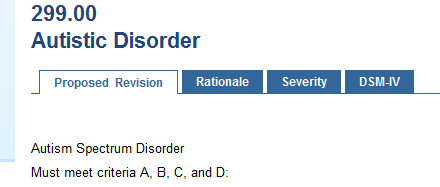
DSM-5 Autism Spectrum Disorders
(still under consideration)


Over the last decade and a half autism has been rising with the numbers of autism disorder diagnoses increasing from 1 in 500 to 1 in 110. There can be no doubt that a significant part of that expansion occurred with the expansion of the diagnostic criteria for autism in the DSM-IV and in particular with the grouping together of autistic disorder and Aspergers Disorder in one category, the Pervasive Developmental Disorder category.  There is no serious dispute that   part of the startling increase in autism disorders is due to the  1994 changes but as 1994 recedes further into the past, and as the number of autism increases continuing to rise significantly the 1994 changes grow less and less credible as a satisfactory explanation for the rising autism disorder diagnoses. With each upward revision in autism disorder estimates by the CDC it is becoming increasingly clearer that we are in the midst of real increases in autism disorders.  Those who deny that autism is actually increasing need help in clinging to their faith like insistence that autism is not rising, that there is no autism epidemic.

The autism epidemic deniers have had to expand, and vary, their diagnostic change arguments to include increased autism awareness and ascertainment, allegedly expanded autism services resulting in diagnostic substitution and so on. Even in the face of December 2009 statements by Dr. Tom Insel, Director of the IACC, that diagnostic change and ascertainment factors could only account for approximately 50% of autism disorder increases the deniers cling to their quasi-religious faith that autism is not, can not, be increasing but they are running out of credible arguments to make their case. Even the deniers insistence that autism disorders are 100% genetic, and therefore could not possibly be increasing, is starting to lose ground to a paradigm which suggests that autism results from the interaction of genetic and environmental factors. The autism epidemic deniers are growing desperate and their assertions that autism is not increasing are growing more tired and unconvincing with each upward estimate in numbers of persons affected by autism disorders. The autism epidemic deniers need help and help may be on the way in the form of a gift from the APA ..... the DSM-5.

The American Psychiatric Association announced in press release 09-65, December 09 2009, that the DSM 5 release date was postponed with publication now scheduled for May 2013.   The postponement is probably frustrating  but, once published, the DSM-5 should still be a gift to autism epidemic deniers. The  DSM-V Neurodevelopmental Disorders Work Group April 2009 Report  recommends that  the Pervasive Developmental Disorder (PDD) category be renamed to the Autism Spectrum Disorders which will officially combine the old PDD disorders into one spectrum of disorders.  The spectrum would be divided according to severity of symptoms with new descriptions of the diagnostic criteria for each category of severity..  

These changes appear to be quite substantial and may, or may not, prove to be of benefit in understanding what are already commonly called autism spectrum disorders.  But with the conversion of the PDD category to an officially recognized autism spectrum of disorders it is inevitable that those who simply do not want to believe that autism disorders are actually increasing will once again point to diagnostic definition change to explain, and deny, any future autism disorder increases. They will certainly argue, at the very least, that the 2013 increase in estimated autism cases renders it impossible to determine whether any post 2013 increase in autism estimates are real or resulting from the 2013 diagnostic changes.

Sixteen years later autism increases are still blamed on the 1994 DSM changes.  The 2013 changes should help  postpone acknowledging the reality of autism increases for at least  a further sixteen years.  The autism epidemic deniers, thanks to this expected  gift from the American Psychiatric Association, will have  a powerful new tool to continue their fight until at least 2029.


Bookmark and Share

Monday, January 25, 2010

Autism Rising? Dr. Eric Fombonne Says Yes It Is

Despite the recent figures from the CDC revising autism prevalence rates upward from 1 in 150 to 1 in 110 die hard deniers of the existence of an autism epidemic refuse to acknowledge the obvious.  One of the most stubborn deniers is Kev Leitch at LBRB a Neurodiversity driven "autism" blog. 

In a recent lbrb post  denying the reality of the increasing rates of autism disorders Kev clings to the 1994 diagnostic changes and to social and ascertainment factors.  He does so even though Dr. Tom Insel, head of the IACC, has recently stated that studies can only attribute slightly less than 50% of the startling rates of increases to such diagnostic and ascertainment factors. The onus, according to Dr. Insel, is on those who would deny that autism is actually increasing to make their case.

Kev's diagnostic and ascertainment factors accounting for less than 50% of the autism increases what is left? Well Kev drops a few names without much explanation.  One of the names he drops, somewhat curiously is Dr. Eric Fombonne.   What makes Kev's reference to Dr. Fombonne so curious is that the good Doctor has previously indicated that autism actually is rising and quite dramatically.  He did so in the context of "debunking" claims that the mercury based preservative thimerosal used in vaccines (including recently in the H1N1 vaccines) does not cause autism disorders (as reported by Scripp news) :

"One of the main pieces of evidence against the vaccine theory, Minshew said, is that thimerosal has been banned from most childhood vaccines in America since 2001, and yet reported autism rates have continued to increase.Dr. Eric Fombonne, an autism researcher at McGill University in Montreal, has an even more telling example of that. In Quebec, children who got vaccines from 1987 to 1991 had about half as much mercury exposure as those in the United States; from 1992 to 1995, they had the same amount; and from 1996 on they had no exposure at all because mercury preservatives were removed. Yet the autism rates in Quebec increased steadily through that entire period, and actually went up faster after the mercury was eliminated."

I do not know if Dr. Fombonne is correct in stating that mercury was removed from all Quebec vaccines or not.  What is relevant for Kev's argument  who cites Dr. Fombonne as an authority for the view that autism is not really rising is the fact that well ... Dr. Fombonne has argued exactly the opposite in trying to prove that mercury based thimerosal in children's vaccines has been exonerated as a cause of autism disorders.   If the increase in autism diagnoses relied on by Dr. Fombonne in defending thimerosal was not a real increase, if it was due entirely to diagnostic and social factors, then Dr. Fombonne's thimerosal defence would be destroyed.

The factors cited by Kev Leitch and other autism epidemic deniers do not account for more than 50% of the autism epidemic. Name dropping of experts like Dr. Fombonne  does not change that fact. Especially when they themselves have publicly relied on real autism increases in arguing against thimerosal as a factor causing autism disorders.

Autism is rising and it is long past time that we started doing the research to find out why.


Bookmark and Share