Wednesday, September 22, 2010

I Voted Yesterday for Adult Autism Residential Care and Treatment

Most votes in the New Brunswick provincial election will be cast on the official election date next Monday, September 27, 2010. I took advantage of the beautiful last day of summer weather and walked to the advance poll in my riding of Fredericton-Nashwaaksis.  In this election there are five parties seeking to form the next provincial government ... the Conservative, Liberal, Green and NDP parties and a new party the Peoples Alliance of NB.  

In New Brunswick we have endured for many years a youth and  adult autism residential care and treatment system consisting of psychiatric hospitals, general hospital wards, the grounds of a youth detention center, out of province and out of country facilities, inadequate group homes with poorly trained staffs and ... community inclusion cliches.  Yesterday I voted for ...... the candidate and party most likely to work for a decent youth and adult autism residential care and treatment system.

It was, as I said, a beautiful day yesterday in Fredericton-Nashwaaksis. Hopefully the voting on September 27 will result in a government that cares about autistic adults and works toward establishing decent adult autism residential care in New Brunswick. That would make for a very beautiful day.


Tuesday, September 21, 2010

Where's Alward on Autism Services?

UPDATE August 1, 2014

New Brunswick is about to commence another election period.  Now Premier Alward has been silent on autism during his 2010-2014 term but his officials have placed more  restrictions on and made it more difficult for students with autism disorders to obtain alternative education settings outside the regular classroom by imposing the Gordon Porter Commandement #1 that all children belong in the regular classroom, all children must be placed in the regular classroom  The Porter Commandment is totally contrary to all informed opinion and evidence based approaches to educating autistic children.  In addition the Alward government is still banishing severely autistic adults and youth to the Psychiatric Hospital in Campbellton on NB's far northern border with Quebec, far from family members in the more heavily populated south and far from NB's autism expertise in Fredericton.  Where's Alward on autism? The answer is clear as the 2014 election approaches : up to no good.


The New Brunswick Liberal Association has a web site and a twitter account which mocks Conservative leader David Alward by portraying him as the comic fictional character Where's Waldo. The Where's Alward effort aims to prompt New Brunswickers, with a touch of comedy, to ask hard questions about David Alward's positions. Since the site and twitter effort though the Conservative Party has issued its platform and has made a number of other policy statements. 

I don't know if it is fair or accurate generally to say that David Alward is absent when it comes to making clear statements of position on various issues. I do know that David Alward has made no statements at all about the 1 in 110 New Brunswickers with an autism disorder or what they can expect from an Alward Conservative government.  Neither David Alward, nor any members of his party, have made public statements about what will happen to early autism intervention programs, Teacher Assistant autism training, or accommodation of autistic students's learning challenges with alternate learning environments ... all areas in which great progress has been during the first Shawn Graham Liberal government.

Would a David Alward government roll back some or all of this substantial progress? Would his government ensure that progress continues to be made in early intervention and education  for autistic children? No one knows because David Alward and his party are not saying.

In the last year of the Graham government discussions moved forward  on the serious issue of adult autism residential care and treatment.  The discussions, with Kelly Lamrock in his role as Social  Development  Minister, centered around the adult autism residential care and treatment  model described by autism expert Paul McDonnell, Ph.D., in the CBC site article Autism Services Needed for N.B. adults. It would be nice if the Alward Conservative Party would commit to the McDonnell model but that would be expecting much from a leader and a party which has no time to even mention the existence of a disorder which affects 1 in 110 New Brunswickers.

I don't know if the New Brunswick Liberal portrayal of David Alward as missing on policy directions is fair or accurate generally.  I do know that, with respect to autism disorders in New Brunswick, it is both fair and accurate to ask ... Where's Alward on Autism Services?

Monday, September 20, 2010

Manganese in Water Tied to Low Child IQs and Should be Studied in Connection with Autism Disorders

A Quebec study of manganese levels in drinking water from municipal wells in eight communities along the St. Lawrence River between Montreal and Quebec City has found , as reported on the CBC,  that manganese significantly lowers children's IQ levels:

The water came from municipal wells and wasn't specially treated for manganese.

"We found significant deficits in the intelligence quotient (IQ) of children exposed to higher concentration of manganese in drinking water," said the study's lead author, Maryse Bouchard of the University of Quebec at Montreal's Centre for Interdisciplinary Studies in Biology, Health, Society and Environment.

"Yet, manganese concentrations were well below current guidelines," she added in a release.

Intellectual impairment

The average IQ of children whose tap water was in the upper 20 per cent of manganese concentration was six points below children whose water contained little or no manganese, the researchers found.

The study looked at 362 children aged six to 13. The amount of manganese from tap water and food was estimated, based on the results of a questionnaire.

Each child was also assessed with a range of tests of cognition, motor skills and behaviour.

Factors such as family income, maternal intelligence, maternal education and the presence of other metals in the water were taken into account.

Even then, few environmental contaminants have shown such a strong link with intellectual ability as manganese, said study co-author Donna Mergler, also at UQAM.

Intellectual disabilities, as reported by authorities such as the Canadian Psychological Association and the US CDC, are present in 75-80% of persons with Autistic Disorder and 41-44% of all persons with Autism Spectrum Disorders generally. It would seem worthwhile to research and explore  the possible relationship between manganese and autism disorders.

Sunday, September 19, 2010

Autism in NB Under an Alward Conservative Government: Rough Trail Ahead?

I am not convinced that the polls, and the media echoing those polls, are correct in predicting a majority government under the David Alward Conservative Party of New Brunswick.  If they are though the next 4 years could see New Brunswick children and adults with autism  traveling on a very rough trail.

There is nothing in the party platform or the public comments of Mr. Alward or Conservative party members to indicate any knowledge of the seriousness of autism disorders or the increasing numbers of persons, now 1 in 110, who carry an autism disorder diagnosis. During an election period priorities are set, in the form of promises made, which will mark the path ahead.  Unfortunately for New Brunswick preschoolers requiring autism specific early intervention, students requiring accommodation for the realities of their specific autism condition, and adults with autism still living in psychiatric hospitals and general hospital wards, their  needs have not been deemed worthy of comment by the Alward Conservative team members.

Even more ominous for New Brunswickers with autism at least two possible members of an Alward Conservative government would be Jody and Jack Carr, the brothers with close ties to the New Brunswick Association for Community Living. The NBACL has done much good work for many with disabilities in New Brunswick. But it actively opposed the specific accommodations for New Brunswick students with autism which have been put in place in New Brunswick and has not followed an evidence based approach to accommodating autism specific needs.

NBACL philosophy dictates that the best place for all students, regardless of the challenges or disabilities of the individual child, and contrary to research and experience of some severely autistic children, is in the mainstream classroom.  NBACL has  steadfastly opposed the type of accommodations made for many autistic children, including my son Conor, during the last four years.  Conor loves attending his neighborhood school where he can go to general areas of the school but receives his autism specific ABA based instruction in a quieter area where he can focus on his learning and is not overwhelmed by the demands of the mainstream classroom. This type of reasonable accommodation was opposed by the NBACL organization in which the Carr family has been very prominent. Hopefully such autism accommodating education gains will not be jeopardized if the pundits prove correct and an Alward-Carr government is elected.

While gains were being made in preschool intervention and autism accommodating education, the Liberal government also held discussions with autism advocates over the past four years about  modernizing the residential care system for youths and adults with autism disorders.  The essence of those autism submissions is summarized in the advice offered by New Brunswick autism expert Dr. Paul McDonnell on his  CBC web site commentary Autism Services Needed for N.B. adults:

"Our greatest need at present is to develop services for adolescents and adults," McDonnell writes.

"What is needed is a range of residential and non-residential services and these services need to be staffed with behaviourally trained supervisors and therapists."
...

"In the past we have had the sad spectacle of individuals with autism being sent off to institutional settings such as the Campbellton psychiatric hospital, hospital wards, prisons, and even out of the country at enormous expense and without any gains to the individual, the family or the community

Among the reforms that the UNB professor is calling for is an enhanced group home system where homes would be connected to a major centre that would develop ongoing training and leadership.

The larger centre could also offer services for people who have mild conditions. But, he said, it could also be used to offer permanent residential care for individuals with more severe diagnoses.

"Such a secure centre would not be based on a traditional 'hospital' model but should, itself, be integrated into the community in a dynamic manner, possibly as part of a private residential development," he writes.

"The focus must be on education, positive living experiences and individualized curricula. The key to success is properly trained professionals and staff. "
  
The McDonnell model of adult autism residential care and treatment is exactly the type of concept that was being discussed with the Liberal government of Shawn Graham.  The Conservative party has shown no inclination in the current campaign to engage in any meaningful discussions about autism disorders. The past history of prominent Conservative candidates Jody and Jack Carr promises more community based philosophy and cliches but no understanding of, and no willingness to reasonably accommodate,  the  specific needs of those with autism disorders.


If the pundits are correct there could be a rough trail ahead for children, students and adults with autism disorders and their families.


Friday, September 17, 2010

No Room for Adult Autism Residential Care on Conservative, NDP Agendas?

For the  Conservatives and NDP  it seems there is no room on the political lifeboat, in troubled fiscal times, for adults with autism disorders. There has been no public mention by these parties  of the existence of persons with autism in New Brunswick. This is no small point. The US Center for Disease Control has estimated that 1 in 110 people have an autism spectrum disorder. Yet neither  the Conservative Party nor the NDP have made  mention on any public media site that I can find of the existence in New Brunswick of persons with autism disorders or what lies in store for them should the NDP or Conservatives form the next government. Both parties have focused on balancing the provincial books as their primary goals and while some promises have been made neither has mentioned persons with autism. 

The last several years have seen very substantial gains made for preschool children and students with autism disorders in New Brunswick.  Autism expert Paul McDonnell has praised New Brunswick as a leader in provision of autism services for preschool and school age students with autism.  But Dr. McDonnell has also pointed out that progress has not happened for adults with autism.  In New Brunswick adults with autism have lived on hospital ward, in psychiatric hospitals and have been shipped out of the province and little has improved over the past 10 years.  Dr. McDonnell has pointed out that we need to invest in adult autism residential care in NB.  The Liberal's Kelly Lamrock had already acknowledged the need to work on autistic adult residential care. Both the PANB and the Green Party of NB have confirmed they would address the issue.  The NDP and the Conservative Party are silent.

I hope I am wrong but it seems  there is no room on the Conservative or NDP agendas, at least  during this election,  for discussion of adult autism residential care.

Thursday, September 16, 2010

Green Party Says YES! To Investing In Adult Autism Residential Care in New Brunswick

On FaceBook The Green Party of New Brunswick has answered my question ``Does Green Party support autism expert advice to invest in adult autism residential care in NB?`` with an emphatic YES!

The  question included a link to the  CBC New Brunswick Votes 2010  expert commentary by NB Clinical Psychologist and  UNB Professor Emeritus (Psychology) Paul McDonnell Ph.D., who has provided advice and support for the establishment of the UNB-CEL Autism Intervention Training Program, the NB autism intervention program for preschoolers and the autism specific  training of teacher assistants and resource teachers in New Brunswick.  As stated in the  article Autism services needed for N.B. adults  Dr. McDonnell emphasized the need for a  modern youth and adult autism care and residential treatment network in New Brunswick:

"In the past we have had the sad spectacle of individuals with autism being sent off to institutional settings such as the Campbellton psychiatric hospital, hospital wards, prisons, and even out of the country at enormous expense and without any gains to the individual, the family or the community," he said.

Enhanced network

Among the reforms that the UNB professor is calling for is an enhanced group home system where homes would be connected to a major centre that would develop ongoing training and leadership.

The larger centre could also offer services for people who have mild conditions. But, he said, it could also be used to offer permanent residential care for individuals with more severe diagnoses.

"Such a secure centre would not be based on a traditional 'hospital' model but should, itself, be integrated into the community in a dynamic manner, possibly as part of a private residential development," he writes.

"The focus must be on education, positive living experiences and individualized curricula. The key to success is properly trained professionals and staff."

Wednesday, September 15, 2010

Molecular Explanation for Autism Reportedly Within Reach

A new  study appears to support the theory that a lack of chemical regulation between synapses is behind at least some cases of autism disorders. The new results are stated to be very preliminary and are discussed  at Molecular Explanation for Autism Within Reach :


"Autism is a disorder that affects numerous children around the world, but now experts appear to be closing in on the molecular agents that appear to underlie at least a portion of all autism cases.


Investigations have thus far been conducted on lab animals, cadavers, and even in a small clinical trials, and the results are encouraging.


The team behind the researches however draws attention to the fact that the work is still in its earliest days, and that even the results are preliminary.


But experts express their hope that one day they will be able to identify these troublesome molecules, and develop new cures based on them.


The main idea about autism that is getting support from the new investigations is that the condition appears due to a lack of chemical regulations in synapses.


These are the small spaces between neurons or nerve cells, through which electrical signals are being transmitted from one cell to the next via chemicals known as neurotransmitters.


The latest clinical trial to support this idea was conducted on about 25 children, all of which were aged 6 to 17. Cambridge, Massachusetts-based Seaside Therapeutics conducted the investigation ...."

NB Votes 2010: PANB Has Strong Autism Platform; Only Party to Mention Autism

You don't have to be a political scientist to analyze the autism policies in most of the party platforms in New Brunswick. With the exception of the People's Alliance of New Brunswick autism does not exist in the party platforms.  The PC, Green and Liberal platforms do not mention the word autism. The NDP platform does not exist as far as I can determine. Only the PANB has an autism plank in their platform but it is a good one:

"PANB recommends

1/ All autistic children have access to 4 hours a day of ABA training through to kindergarten.

2/ All autistic children have access to 1-2 hours a day of ABA training through all school years until graduation either from high school or university as part of their standard school day.

3/ All autistic children should be taught in school using ABA methods by ABA trained TA’s as this is proven to improve their learning ability

4/ The creation of both an Adult care facility and a Youth care facility be built in Fredericton in conjunction with the Stan Cassidy Center which will care for those Autistic individuals who can no longer be cared for by the normal caregivers of these individuals. This care should focus on multiple facets but should include ABA training to create the possibility that even adults could potentially be helped by ABA be given that opportunity.

5/ All autistic individuals even after graduation should have access to ABA training for short term or long term if there ability to function properly in society diminishes or disappears for any reason.

6/ An attempt to find a further cure and treatment options should be continued through partnership with the Universities in this province, The Stan Cassidy centre and the Federal government

7/ As it has been determined by various parents of autistic children that not in all situations does full integration work with ALL autistic children, A program should be put in place that would allow parents and resource workers as well as TA’s to work together to create a modified part time integrated program that would better meet the needs of the individual student if the situation warrants this.

8/ changes to the disability benefit to allow staggering levels of benefit that recognizes the level of care required as well as the requirements to replace property increasingly due to high increase in breakage due to rocking behaviours etc common amongst autistic children.

9/ Summer autism camps during school breaks should be made available to allow children the ability to socialize with those like themselves amongst trained carers.

It should be realized that both the Liberals and Conservatives were made aware as far back as 2005 of the necessity of a Care Facility in this province when it was made public during the Conservative years of that time that we were being forced to send those individuals with autism that required long term care to Maine to be housed there as we had no facilities in this province. The conservatives of the time had no interest in developing a treatment center.

During this period the Liberals were vocal in their disapproval of the fact our citizens were being cared for out of country due to no facilities in this province however their dedication to this file was shown during the recent 4 years when no attempt at creating a long term care facility was done regardless of repeated requests.

John Foran was aware of a case in 2005 where a youth was housed at the Miramichi Youth Centre under the direct care of 2 carers from a private company at the cost of 700$ a day because we did not have the facilities in this province to properly house him and from there he was transferred to Maine because the Conservatives would not address this lack of facility.

And yet during the entire 4 year mandate of the liberals not one thing was done to change this lack of care centres either.

PANB is the only party that will push for a drastic improvement to how these autistic individuals in our care are treated."

Tuesday, September 14, 2010

New Brunswick Leads in Preschool & Student Autism Services But Adult Autism Needs Must Be Addressed


Autism expert Paul McDonnell Professor Emeritus (Psychology, UNB), Clinical Psychologist, and  a  major force behind the great progress that has been made in provision of preschool and school autism intervention and education services in New Brunswick,  has provided expert analysis of autism issues to the CBC. In two features, Paul's analysis, and his interview by CBC reporter Dan McHardie, Paul speaks about the leadership role New Brunswick has taken on in providing excellent preschool and school autism services but also points to  the need to address youth and adult autism needs including adult care residential needs as set out in the interview:

"Our greatest need at present is to develop services for adolescents and adults," McDonnell writes.

"What is needed is a range of residential and non-residential services and these services need to be staffed with behaviourally trained supervisors and therapists."
...

"In the past we have had the sad spectacle of individuals with autism being sent off to institutional settings such as the Campbellton psychiatric hospital, hospital wards, prisons, and even out of the country at enormous expense and without any gains to the individual, the family or the community

Among the reforms that the UNB professor is calling for is an enhanced group home system where homes would be connected to a major centre that would develop ongoing training and leadership.

The larger centre could also offer services for people who have mild conditions. But, he said, it could also be used to offer permanent residential care for individuals with more severe diagnoses.

"Such a secure centre would not be based on a traditional 'hospital' model but should, itself, be integrated into the community in a dynamic manner, possibly as part of a private residential development," he writes.

"The focus must be on education, positive living experiences and individualized curricula. The key to success is properly trained professionals and staff."

Sunday, September 12, 2010

Boston Globe's Cheap and Dirty Misrepresentation of Autism and Autism Issues

In "Lessons on living with autism" Boston Globe columnist Joanna Weiss has presented without any contrary view, critique or informed context the views of the founder of the College Internship Program and its founder Michael McManmon on a number of autism related issues. In Weiss World autism is high functioning autism and Aspergers.  In Weiss World autism is not a medical disabilty at all, it is a social disability. It is the "autism" of Mr. McManmon who, according to the article, "probably" has Asperger's:

"For McManmon, self-knowledge came years after he founded the program. It was his staff that pointed out that he probably had Asperger’s, which explained his vast energy, his entrepreneurial skills, his trouble managing personal relationships. It also explained his interest in 1984 — when kids with social disabilities were getting deinstitutionalized — in finding ways to ease their transition to independent life."

Joanna Weiss takes a cheap and dirty shot at parents and professionals who seek to find cures for autism without mentioning the differences in severity that make Autistic Disorder much more than social awkwardness for the majority of persons who suffer from the medical disorder:

"The question of how to help them isn’t flashy, controversial, or celebrity-studded. That may be why far more attention goes to the torrid debate over autism’s causes, the hunt for ways that the disorder can be “cured.’’

The staff at the College Internship Program chafes at the notion that autism is something to cure or defeat. A diagnosis is a piece of your identity, says the program’s founder, Michael McManmon. His philosophy centers on self-knowledge. “If you understand who you are and what makes you tick,’’ he said recently, “then you can alter it and you can fit into the world.’’

So there you have it. For Michael McManmon, who "probably" has Asperger's , and for Boston Globe columnist Joanna Weiss who offers his opinions without contrary perspective or context, "autism" is just a social thing.  Questions about cause and cure of autism are torrid and flashy bits of celebrity studded nonsense. They are not questions that agonize parents of children with actual Autistic Disorders  who live with their child's self injury, danger of being lost from ordinary life realities like automobile traffic, or the intellectual disability which characterizes the "vast majority".  In Weiss World those with "autism" do not  end up living in institutional care. For Joanna and Michael autism is just some social awkwardness that can be addressed with a journey of inner discovery.

From this article it seems that Micheal McManmon might or might not have Asperger's.
From this article it seems that Joanna Weiss might or might not be a fair and competent journalist.

Thursday, September 09, 2010

Best Autism Tweet of the New Brunswick Election From Liberal Kelly Lamrock

  " klamrock: Still more to do on #autism file. We'll work w/parents to address adult care incl community-based residential care #nbvotes

4 days ago via Mobile Web · Reply · View Tweet "


Over the last 4 years the Liberal government honored a commitment by Premier Graham to provide  4 years of UNB-CEL Autism Intervention Training to classes of approximately 100  teacher assistants and resource teachers a year over the objections of some senior Education officials, who actually knew little about autism. They also faced opposition from some union officials who opposed autism specfiic training for TA's. I was involved in many of the discussions and I can tell you from personal knowledge that it was a very tough fight to do the right thing for New Brunswick's autistic students. I can tell you from very direct, personal involvement that Kelly Lamrock and the Shawn Graham Liberal government honored their commitment and put the interests of NB's autistic students ahead of vested adult interests.
When Kelly Lamrock says that a Liberal government will work with the parents to address the address adult care including community based residential care this father of a severely autistic 14 year old son, who has been involved very intensely with the changes that have made New Brunswick a leader in pre-school intervention and education of autistic children says ... I believe Kelly Lamrock and a Liberal government will keep their word. I believe it because I have already seen them do it.  
 

Wednesday, September 08, 2010

Adult Autism Care in New Brunswick: If Not During This Election WHEN?

"If you don't understand autism, things can become very bad very quickly.  We have been pushing for (better facilities) in New Brunswick for several years. This is not a crisis that has popped up in the last two days. Residential care is a critical element for these people and it is not being provided." 
Harold Doherty, 2005
It has been five years since Canadians learned that an autistic youth who had committed no offence was being housed on the grounds of the Miramichi youth correctional facility (see article following)  solely because there was no adequate accommodation for him in New Brunswick while he waited admission to the Spurwink facility in Maine.  A residential care and treatment facility for autistic youths and adults still does not exist in New Brunswick. If the group homes are not adequate for the more severely autistic they are either sent outside of the Province, sent to the psychiatric hospital in Campbellton or in one case at least in Saint John live, at least temporarily on a hospital ward. In some cases severely autistic adults live in their parents home, sometimes wearing protective gear and with some assistance. But no decent residential treatment facility exists for New Brunswick's most severely autistic youths and adults.
If we do not discuss adult and youth residential care during this New Brunswick election WHEN will we ever  get around to it? 
WHEN will severely  autistic youths and adults have decent residential care and treatment in New Brunswick?


No other place for him to stay 13-year-old must go to U.S. hospital 
No other place for him to stay
13-year-old must go to U.S. hospital

The Toronto Star, KELLY TOUGHILL, ATLANTIC CANADA
BUREAU, Oct. 19, 2005
HALIFAX—A 13-year-old autistic boy now living in a New Brunswick jail compound will be sent out of Canada because there is no home, hospital or institution that can handle him in his own province Provincial officials confirmed yesterday the boy is living in a visitor's apartment at the Miramichi Youth Centre and will be moved to a treatment centre in Maine by November.
They stressed he is not under lock and key, has no contact with other inmates and is living outside the high wire fence that surrounds the youth detention centre.Nevertheless, the jailhouse placement and the transfer to Maine have outraged mental health advocates and opposition critics.
"They put this boy in a criminal facility because he is autistic," said Harold Doherty, a board member of the Autism Society of New Brunswick"Now we are exporting our children because we can't care for them. This is Canada, not a Third World country.``We are supposed to have a decent standard of care for the sick and the vulnerable, but we don't." 
 
Liberal MLA John Foran echoed his concern. "This boy has done nothing wrong, is not the subject of any court order, but is in a penal institution." Provincial officials yesterday insisted critics are misrepresenting the nature of the boy's situation and that in fact the province has done everything it can to help him. "This individual is not being held, and is not incarcerated," said Lori-Jean Johnson, spokeswoman for the family and community services department. "He has housekeeping, bath and a separate entrance. We are just utilizing existing resources."
Privacy laws prevent officials from discussing anything that would reveal the boy's identity, including details of his previous living situation and the whereabouts of his parents. This much is known: He suffers from a severe form of autism and is a ward of the state, under the guardianship of the minister of family and community services. He was living in a group home until recently, but became so violent that he was judged a danger to himself and others. At a psychologist's recommendation, he was moved to a three-bedroom apartment on the grounds of the Miramichi Youth Centre, a prison for about 50 young offenders. Two attendants from a private company watch the boy around the clock, at a cost to taxpayers of $700 a day. Johnson said she does not know any details of his care. 
Doherty said the jailhouse placement and move to Maine highlight the desperate need for better services for autistic children in New Brunswick and across Canada. He said staff at most group homes in New Brunswick aren't trained to deal with autism and don't understand the disorder. "If you don't understand autism, things can become very bad very quickly," said Doherty, who has a 9-year-old son with the disorder. "We have been pushing for (better facilities) in New Brunswick for several years. This is not a crisis that has popped up in the last two days. Residential care is a critical element for these people and it is not being provided."
Johnson said the provincial system of group homes and institutions that care for children and adults with psychiatric disorders and mental disabilities works for most people. "We do have existing resources, but once in a while, there will be an exception. Here, we are looking at a very extreme case." The boy will be moved to an Augusta, Me., treatment centre at the end of the month, said Johnson.
The centre, run by a non-profit group called Spurwink, specializes in dealing with autistic adolescents. A Spurwink representative did not return a phone call from the Toronto Star. Provincial officials could not detail the cost to keep the child at Spurwink, nor did they have information about why he's being sent to Maine, rather than a Canadian facility in another province.

Tuesday, September 07, 2010

Addressing Residential Care Needs of Autistic Adults is New Brunswick's Top Autism Priority

Autism is NOT only a childhood disorder.   Autistic children grow up and become adults and many will not lose entirely their autism challenges. While recovery has been reported in some credible agencies by means of intensive early intervention and addressing related biomedical issues many autistic adults will require assisted living and some will require secure residential facilities and access to specialized services and treatments. In New Brunswick both autism advocates and government began to make progress in providing autism services first to preschoolers and subsequently to autistic school children.  But little substantial progress has been made in provision of  decent residential care to autistic adults.

The group home system in New Brunswick  is not a success. As a lawyer I have represented autistic youths in the Courts in New Brunswick who could not function in New Brunswick group homes. I have seen cases where such youths were charged as a result of alleged assaults arising out of confrontations between youths with autism or Aspergers and untrained staff.  I visited the Centracare facility in Saint John and the Campbellton psychiatric hospital in Saint John where some of our most severely autistic adults have resided. I know that some have been sent out of the country for periods of time to facilities in the United States. I received an email from a parent in Saint John whose autistic child essentially lived on a hospital ward.

Some autistic children will benefit greatly from the ABA services now available in New Brunswick, services which were not widely available 10 years ago.  Some will live independent lives but others will not. If we do not focus, if we, government and parents,  do not advocate now for autistic adults and make it a top autism priority more autistic children will grow up and live on hospital wards in Saint John and Campbellton.

Adult autism residential care is a long overdue priority for autism advocacy and services. If we do not focus on the provision of adult autism care now it will not get done. More of New Brunswick's autistic children will grow up and live their lives in conditions no one wishes for their children.

Parents, grandparents, family members and friends of autistic children and adults in New Brunswick.  People are knocking on your door during this election.  They are asking for your vote. Tell them we need a modernized residential care system for autistic adults. Better still don't wait for them to knock on your door. Email them, FACEBOOK them, tweet them, write them. Call their campaign office. But let them know that adult residential care is New Brunswick's top autism priority. Let's focus. Let's make it happen.

Monday, September 06, 2010

Autism and High School: Conor's Final Preparation


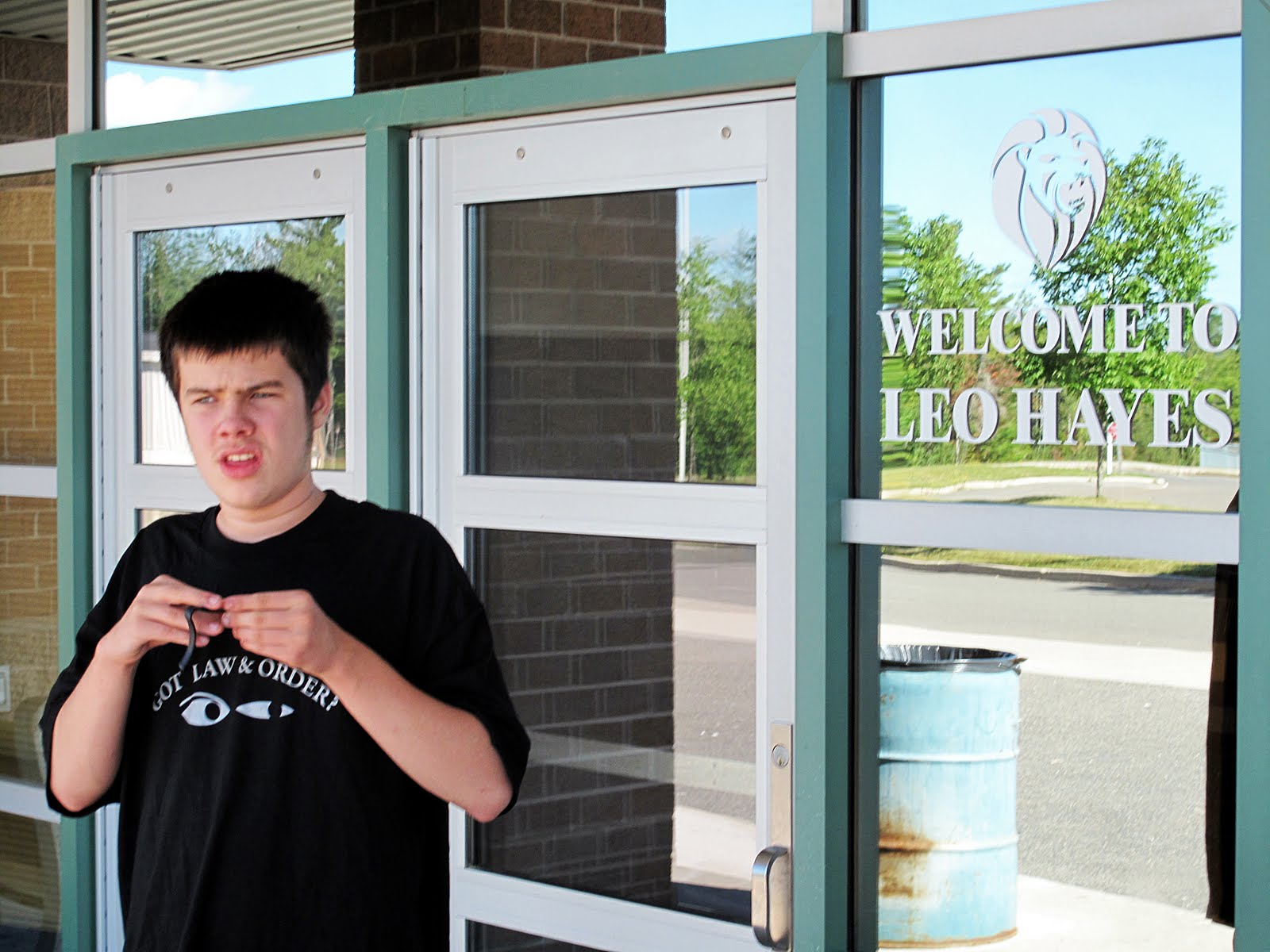
Conor has been anxious to return to school; literally counting down each day and telling Mom and Dad how many days left until school. Today was ONE DAY left!.  Last year we did some transition planning for Conor's move from Middle School to High School.  Together with Middle School, High School and District 18 representatives we prepared Conor, as best we could, for the transition to High School.  The planning included actual visits to Leo Hayes High School and work with the UNB-CEL Autism Intervention trained  Teacher Assistants who will be working with Conor this year. They also visited Conor at Middle School and spent some time working with him there before the end of the year.  Hopefully that familiarity with the place, and with some key people, will help ensure a smooth transition. Today, with more fine weather, I took Conor for a visit to Leo Hayes High School just to see the building, one more time,  where he will be attending school tomorrow.  

Sunday, September 05, 2010

I Am Voting Autism in the New Brunswick Election, I Am Voting Liberal


Shawn Graham, TJ Burke, Mary Schryer, Kelly Lamrock

The New Brunswick election is well under way, as the CBCNews NB Votes 2010 election countdown ticker tells us, with 22 days left until Election Day.  At this stage it is my hunch that autism services  will not receive any specific commitments from the parties.   Unless something dramatic, in the nature of a strong autism specific commitment to a new, modern residential care system for autistic adults emerges from one of the parties though this father of a severely autistic 14 year old son intends to vote Liberal.

Long before the last election took place autism groups advocated for early intervention and autism specific training for teacher assistants and resource teachers working with autistic students in New Brunswick schools. Many discussions took place with government and opposition political leaders. The then Conservative government of Premier Bernard Lord took some initial steps and Premier Shawn Graham's Liberal government developed those services substantially; particularly in New Brunswick schools.  The fact that autism advocacy groups, in direct discussion with the political leadership, played such a significant role in helping shape autism services in the schools did not always sit well with the interests of some career people in the Department of Education who opposed the changes and fought them, in some cases tooth and nail.  The changes were implemented though, after further study by then Liberal Education Minister Kelly Lamrock, and the autism commitments made by Premier Shawn Graham were honored to the great advantage of many New Brunswick students with autism disorders, including my son Conor.

Although both Conservative and Liberal governments have helped New Brunswick's autistic children in the past   autism specific commitments are not being discussed by any political party.  None of the three other parties, the NDP, the Green nor the new People's Alliance of New Brunswick have any hope of forming the next New Brunswick government.  

It is the prospect of further progress on advancing autism services, particularly for New Brunswick's adult autism population, that has me leaning strongly towards voting Liberal on September 27 2010. I will vote Liberal in the next election, in the likely absence of any autism specific commitment from the parties, because I know that the Liberal government including Shawn Graham, Kelly Lamrock, Mary Schryer  and TJ Burke, has a proven track record of helping autistic children in New Brunswick and I know from direct discussions  that they are solidly committed to helping with those with autism.  

Although I never had the opportunity to talk directly with former Conservative Premier Bernard Lord and former minister Tony Huntjens they did demonstrate a commitment to helping New Brunswick's autistic children.  Neither, however, are running in this election and Conservative leader David Alward has shown no substantial  interest in autism issues specifically, or in education, social or health issues generally.  His comments about requiring "volunteer" community service before New Brunswick students can graduate from High School cause me concern. The concept of requiring voluntary service seems illogical and contradictory. To this father of two high school sons Mr. Alward's comments also  suggest a  lack of sophisticated understanding of education issues.

The next great autism challenge in New Brunswick is to reform and modernize the residential care and treatment system for our  autistic adults.  The current group home system is inadequate for those who live there on many fronts include diet, recreation and access to treatment. The group home system as it is currently set up does not work at all for the lowest functioning autistic adults in New Brunswick who have  ended up living out their lives in psychiatric hospital wards in Saint John and Campbellton.

Current Health Minister Kelly Lamrock has stated that his department is studying, and working on the residential care system for New Brunswick autistic adults.  I know that autism groups, in which I have been included at times, have made representation on this issue. I believe Kelly Lamrock, who I have met and talked with many times, to be a  knowledgeable and trustworthy individual.  I believe that Kelly Lamrock will oversee the development of an autism specific residential care system for autistic adults.

I have   also met Premier Shawn Graham and discussed autism issues with him.  He committed to the Autism Society that his government would  train four years of classes of teacher assistants and resource teachers at UNB-CEL's autism intervention training program. Shawn Graham  kept that promise. He did so despite at times intense opposition from  interests within the Department of Education.

Like many New Brunswickers I was surprised and disappointed with Premier Graham's  reversal of his campaign commitment concerning NB Power.  I expressed my disappointment publicly but I think that Premier Graham entered into the NB Power deal  because he genuinely believed it was in the best interests of New Brunswick and felt that his first commitment, his first obligation as Premier,  was to govern in the best interests of New Brunswickers.    I believe that as a Premier he learned much from, and grew from,  that experience. And at the end of the day autism issues really carry my attention and Premier Shawn Graham has done much to help autistic children and students.

When we make our marks on election day it is for a local candidate in each riding. In this riding TJ Burke is the Liberal candidate and his personal and professional qualities are well known.  I know him as an MLA who I believe has represented our riding well in the Legislature. I know him as a very capable lawyer.  TJ Burke has always been very supportive on autism issues and even while the Liberals were in opposition he went out of his way to stop and talk with me at autism rallies I was involved with in Fredericton. I have talked with TJ several times about, and  know that he has been genuinely interested in, adult autism issues, and would be, if the Liberals are re-elected,  a strong supporter of improvements to New Brunswick's autistic adult residential care system.

On September 27  I will not be casting a protest vote or voting in anger. My vote will not be shaped by cynicism.  I will be voting for the party that I believe is most likely to help New Brunswick's autistic adults with a modernized autism specific adult residential care system, hopefully one with an enhanced facility located centrally in Fredericton near the autism expertise at UNB and the Stan Cassidy centre. I will be voting for the party that I know to be committed to, and knowledgeable about, autism generally. 

I mean no  disrespect toward the other parties, leaders or candidates.  But on September 27 I will be voting Autism.  I will be voting Liberal. 

Thursday, September 02, 2010

For Michelle Dawson Autism Is Whatever She Says It Is


(Left photo is of the Campbellton Regional Hospital home to some persons with low functioning autism.)

Michelle Dawson gained fame in Canada by intervening as  an "autistic" in the Supreme Court of Canada case in Auton where she opposed parents seeking government funded ABA treatment for their own autistic children.    Notwithstanding that ABA is, and was at that time, the most evidence based effective intervention known to assist autistic children in overcoming the deficits posed by their autism disorders Ms Dawson opposed ABA, apparently, as far as I can tell, because she did not feel that ABA research met her own  self described high standards of "science". 
When I say that ABA was the most evidence based effective intervention for autism I am not relying on my opinion which, admittedly, is of little or no weight.  I am relying upon the several public health and research authorities,  including the Office of the US Surgeon General, who, by the time of the Auton case, had already reached that conclusion. But of course Michelle Dawson, adult diagnosed and undefined "autistic", disagreed. She was able to appear as an intervenor at the Supreme Court of Canada because of the supporting affidavit of Dr. Laurent Mottron who shares some of her other ideological views including the "notion" that curing autism is "nonsense". (As summarized by the Canadian Human Rights Tribunal in Dawson v Canada Post where the mysterious "Dr. M" and Ms Dawson gave their gut feeling, unscientific opinions about curing autism).

Now Michelle Dawson is at it again, in  Are you high or low functioning? Examples from autism research  with yet another one of her silly attacks on the idea that one can distinguished between levels of severity or functioning with respect to autism disorders. I don't pretend to understand the logic in her position or in the position of anyone who asserts that it is not possible to distinguish between severity levels of autism.  Michelle Dawson, who claims to be autistic, was by the account in the CHRT case against Canada Post a very good postal worker.  As a former Canada Post labour lawyer I can assure you that the challenges faced by the inside Postal Workers and Letter Carriers are complex and demanding.  I have great admiration for each postal worker. The fact that Ms Dawson was, on the evidence, excellent at her work with CPC is a very real indicator that she is indeed a high functioning person, autistic or not. My severely autistic son does not understand anything about letters or postal systems and so on.  He is barely literate and has minimal functional ability in language period.   Michelle Dawson is a very high functioning "autistic". My son Conor, diagnosed with Autistic Disorder is very low functioning. Those are obvious, common sense realities.

In her life Michelle Dawson has moved from being an excellent letter carrier to being an autism researcher. IMHO she has not distinguished herself as a researcher but her ability to earn a living in research places her far, far above the functioning levels of people, like my son, who are severely affected by autism disorders. Her research career places her far, far above the adults with autism that I have actually visited with and met in psychiatric care hospitals in Saint John and Campbellton, New Brunswick. But those are common sense observations and distinctions.  Common sense is noticeably lacking in the writings and anti-ABA crusades of Michelle Dawson.
Michelle Dawson's latest critique of functioning levels and severity levels in autism disorders (you won't find autism referred to as a disorder in her commentary) carries with it an odor  of hypocrisy.   She mentions how discussion of autism functioning and cognitive levels has become politicized without mentioning her own role in contributing to such politicization. Ms Dawson critiques the notion of severity and functioning levels and provides examples without mentioning the name of her mentor Dr. Laurent Mottron who's supportive expert testimony enabled her appearance before the Supreme Court of Canada and was of assistance to her case against Canada Post before the Canadian Human Rights Tribunal.   Dr. Mottron's career has been distinguished by volumes of research involving .... HIGH FUNCTIONING ... "autistics".

Dr. Mottron was careful to reference his subjects' functioning level in his study reports .... and his subjects were almost subjects with high functioning autism and Aspergers:


Locally oriented perception with intact global processing among adolescents with high-functioning autism: Evidence from multiple paradigms


traininautism.com [PDF]L Mottron, JA Burack, G Iarocci, S … - Journal of Child …, 2003 - interscience.wiley.com


Local and global processing of music in high-functioning persons with autism: beyond central coherence?


brainmusic.org [PDF]L Mottron, I Peretz, E Menard - The Journal of Child …, 2000 - Cambridge Univ Press... In terms of local processing, we found that persons with high-functioning autism performed better than the com- parison group when AP could ... we also found that persons with autism used a more local graphic strategy than typically developing participants (Mottron, Belleville, et ...Cited by 125 - Related articles - BL Direct - All 12 versions


Matching strategies in cognitive research with individuals with high-functioning autism: Current practices, instrument biases, and recommendations


aspires-relationships.com [PDF]L Mottron - Journal of Autism and Developmental Disorders, 2004 - Springer A meta-analysis was performed on the 133 cognitive and behavioral papers in autism using
com- parison groups in the 1999–2002 period. High-functioning (average IQ: 84.7), adolescents
(average, 14.4 years) are largely dominant. IQ is the most frequent matching variable in ...
Cited by 54 - Related articles - Get at CISTI - All 8 versions


Atypical visual orienting to gaze-and arrow-cues in adults with high functioning autism


… , JEA Stauder, IAM van Son, L Mottron - Journal of autism and …, 2005 - Springer
The present study investigates visual orienting to directional cues (arrow or eyes) in adults with
high functioning autism (n = 19) and age matched controls (n = 19). A choice reaction time paradigm
is used in which eye- or arrow direction correctly (congruent) or incorrectly (incongruent) ...
Cited by 24 - Related articles - Get at CISTI - All 7 versions


A Study of Memory Functioning in Individuals with Autism

Laurent Mottron a1 c1, Karine Morasse a2 and Sylvie Belleville a3


Abstract Memory tasks were administered to 14 high-functioning individuals with autism  and 14 typically developing individuals matched on chronological age and verbal intelligence

EEG spectral analysis of wakefulness and REM sleep in high functioning autistic spectrum disorders


Anne-Marie Daousta, Élyse Limogesa, Christianne Bolduca, Laurent Mottron, Roger Godboutab
Accepted 15 January 2004.


Abstract Objective


The aim of this study was to investigate the involvement of temporo-occipital regions in the pathophysiology of autistic spectrum disorders (ASD) by using REM sleep and waking EEG.


In Michelle Dawson's Autism world distinctions between low and high functioning autism are arbitrary. I can't wait to see the sequel to her commentary when, hopefully, she will analyze and comment on the many, many studies published by her colleague, High Functioning Autism expert, Dr. Laurent Mottron.  It will also be interesting to see Ms Dawson's own research involving non verbal "autistics" living in psychiatric hospitals and other secure institutions because they are too low functioning to live in most group home settings.

Wednesday, September 01, 2010

Heat Warning? Who Cares? Conor Has Some Circle Place Fun While He Waits For Mom!

Conor helped out again with the groceries at the local Superstore today. While we waited for Mom to proceed through the checkout Conor and Dad went out doors for fresh air even though there was a heat warning on for Fredericton today and some establishments closed mid afternoon.  The heat didn't bother Conor though as we headed to the nearby Lawrence Amphitheatre, Conor's "Circle Place", where he stretched his legs on the cement semi circles of the Amphitheatre.