Showing posts with label autism education. Show all posts

Thursday, February 07, 2013

Autism Society New Brunswick Invitation to Premier Alward, Ministers, Opposition Leaders to Attend ASNB AGM


February 7, 2013


Dear Honourable Premier Alward, 
Honourable Ministers, 
Respected Leaders of the Liberal, NDP and Green Parties of New Brunswick

You are all respectfully invited to attend the 2013 annual meeting of the Autism Society New Brunswick scheduled for March 23, 2012 commencing at 12:30 at MacLaggan Hall, UNB Fredericton.  The meeting will be open to anyone in New Brunswick affected by or with an interest in autism spectrum disorders.

The Centers for Disease Control (CDC) in the United States currently estimates that 1 in 88 persons will be diagnosed with an autism spectrum disorder (ASD).  The primary diagnostic features of autism as set out in the DSM and ICD diagnostic manuals indicate three primary concerns of deficits in  social, communication and restricted, repetitive and stereotyped patterns of behavior, interests and activities. Serious features often found in conjunction with autism include intellectual disabilities, epilepsy and seizure activities, sensory issues and self injurious behaviours.

In our province the Autism Society New Brunswick and our parent members have been instrumental in advocating successfully for evidence based early intervention for children with autism disorders. We were actively involved in assisting in the creation of  the internationally recognized UNB-CEL Autism Intervention Treatment program.  Our advocacy prompted the UNB-CEL autism training of approximately 500 education aides and resource teachers. 

It was also the ASNB representation during the inclusive education reviews  of the Lord and Graham administrations (MacKay,Ministerial Committee) that helped ensure the emphasis in the PNB definition of inclusive education on a student focused, individualized,  evidence based approach to inclusive education.  We have further advocated for the maintenance of a range or continuum of learning and placement alternatives in providing inclusive education; consistent with principles enunciated in Canadian case law such as the recent Moore decision of the Supreme Court of Canada and by credible autism authorities such as the TEACCH Autism Program at the University of North Carolina. 

ASNB and our representatives have also advocated persistently, albeit with very limited results, for systemic improvements in adult services.  One key area that has repeatedly been brought to the attention of government, and for the most part ignored,  is the need for an enhanced network of residential care and treatment  for New Brunswick adults with autism as described by respected New Brunswick autism expert Paul McDonnell.  

The adult care issues are of grave concern and have not been seriously addressed in NB at all.  There are also serious concerns among parents about a perceived regression in provision of early autism intervention with valuable early intervention time being lost needlessly by bureaucratic and service provider procedures. In our schools the quality and integrity of the UNB-CEL autism training has been replaced by an in house autism training model which the ASNB objected to strenuously over many years.  Pressures are continually being exerted to place all students with autism disorders in regular classroom settings contrary to the legal and professional requirements noted above for a continuum or range of education settings and service delivery based on the needs of the individual students.

The issues articulated are  provided in an attempt at candid, courteous discussion of issues that are of fundamental importance to our ASNB members and persons affected by autism. They are provided to avoid surprise and to allow any respected invitees who choose to attend to come prepared for discussion without fear of being "bushwacked".   This invitation will itself be placed in regular and social media consistent with ASNB practice of transparent, arm lengths and public approach to autism advocacy that has worked so well in dealing with previous administrations. 

if you choose to attend you will be welcomed on behalf of the  1 in 88 persons in New Brunswick and their families. Kindly reply as soon as possible  to this email if you wish to attend so that preparations can be made to accommodate any needs, requirements or concerns you might have in attending. 

Respectfully,
  
Harold L Doherty
Acting President (ASNB, 2012 AGM)
Autism Society New Brunswick

cc.  ASNB, media  

Saturday, April 21, 2012

Autism Education in the Era of the NBACL Inclusion Government


The New Brunswick Association of Community Living now determines inclusion and disabilities policies in the New Brunswick government with immediate repercussions in the  Department of Education and Early Childhood Development ... to the detriment of many children with autism disorders.  While always very influential in NB government education decisions the NBACL is now effectively in charge of disability and inclusion policies in New Brunswick schools. The ramifications for children and students severely affected by autism disorders and intellectual disabilities are very serious.  Independent, quality, autism specific training has been abandoned in favor of in house training and more and more pressure will be brought to bear on district and school officials to require all children receive instruction in a mainstream classroom even those for whom the mainstream classroom causes physical harm and disrupts their learning and development.

In the decade preceding the election of the Alward government New Brunswick made many gains in providing providing evidence based autism interventions to New Brunswick preschoolers and students over the decade preceding the Alward government election.  Those gains were provided via UNB-CEL Autism Intervention Training, a program recognized by US autism experts David Celiberti and Eric Larsson as a model for other Canadian and some US jurisdictions.  Those of us who advocated for these autism specific services were opposed strenuously by the very well connected and influential New Brunswick Association for Community Living.  Now, under the Alward government the NBACL is even more influential. NBACL actually sets Alward government disability policy and ensures compliance by Education officials from the Deputy Minister level down to the teachers and aides that deliver the programs.  Along the way the UNB-CEL Autism training has been dropped in favor of in house "training" and a renewed push for dumping all children in the mainstream classroom without regard for whether the classroom is the appropriate learning environment for them.  There is no room for flexibility or accommodation of children and students with severe autism disorders with intellectual disabilities in the NBACL Department of Education and Early Childhood Development. 

New Brunswick Premier David Alward has publicly acknowledged the role of the New Brunswick Association of Community Living related organizations in setting inclusion and disability policy in New Brunswick as was made clear on the community living organizations' IRIS site. IRIS is the Institute for Research and Development and Inclusion in Society. It purports to be the "research" branch of Community Living Assocations across Canada. The IRIS board of directors consists of present and former Community Living Association officials from accross Canada including former NBACL official Lorraine Silliphant.  In February 2012 IRIS spent a week indoctrinating high ranking New Brunswick education officials including Deputy Ministers and Assistant Deputy Ministers in the Community Living Association philosophy based policies of full mainstream classroom inclusion as was bragged about on the IRIS web site:

"New Brunswick Premier David Alward issued a letter Friday February 4th to all participants in the ‘Policy Making for Inclusion – Leadership Development Program’ that will be delivered in Fredericton by IRIS February 6-10 to senior officials with the Government of New Brunswick. The program is designed to assist policy makers achieve the government’s platform commitment to “enable New Brunswickers with disabilities to actively participate in all aspects of society and take their rightful place as full citizens.” With Deputy Ministers, Assistant Deputy Ministers, Human Resources Directors and Policy/Program Directors from across government participating in the week-long series of leadership development workshops, major strides will be taken towards creating a public service in New Brunswick ready and able to deliver on the government commitment to people with disabilities. In his letter, Premier Alward thanked The Institute “for developing this program to inform our public servants on the latest research on disability and inclusion…” A core resource for the program is the guide to Disability and Inclusion Based Policy Analysis just published by The Institute."

Even without the indoctrination of high ranking government officials in a week long session of Community Living policies the NBACL exercised a dominant role in the NB government.  NBACL official Krista Carr is the wife of Early Education and Childhood Development Minister Jody Carr.  Minister Carr's brother Jack Carr, also a member of the governing Alward Conservatives, is a former NBACL employee. Gordon Porter, an icon of the NBACL and CACL organizations, was a member of the Alward transition team and is now conducting yet another inclusion review with the aid of NBACL friendly team members.  Only views consistent with the NBACL total inclusion beliefs are tolerated.  In the past high school principals have been trained by NBACL officials who handed out awards annually to teachers who exemplify best (as in NBACL compliant) inclusion policies.

Admittedly the cliches and buzz words sound good. Community Living Association spokespersons never tire of telling us how awful things were in the bad old days before they changed everything for the better.  The NBACL, the CACL, IRIS and other CLA groups never, ever, acknowledge the evidence of the harm they have caused to some people by their fanatical obsessions like total classroom inclusion for all.   My son with severe autistic disorder and intellectual disability suffered in a mainstream classroom.  Conscientious educators locally, who actually work with and know my son have accommodated him with a flexible inclusion model, a model which is now at risk in the NBACL Department of Education and Early Childhood Education era.  The NBACL aristocracy that sets and enforces inclusion policy does not mention evidence like my son's case, that contradicts their everyone in the classroom philosophy.

So too the total inclusion extremists pay no attention to severely impaired adults who can not live in an ad hoc, loosely monitored group home system make no mention of the adults with autism disorders and intellectual disabilities living in psychiatric facilities in NB.  Instead they pretend all is swell, give each other awards, pat each other on the back incessantly and fight efforts to establish or even discuss an intermediate level of residential care with professionally trained assistants and higher levels of security for those who need such interventions.

There is no evidence to support the policies of the NBACL which now sets inclusion policies for New Brunswick government departments including Education and Early Childhood development. The evidence based consideration of the  best interests of individual students is in serious, serious threat of extinction in the NBACL dominated Alward government era. Specialized training such as that provided by the UNB-CEL Autism training program is now gone.  Flexible inclusion policies such as that which have accommodated my son with autism specific instruction will be targeted.

The NBACL is in charge.

Thursday, August 25, 2011

60 Essential Twitter Feeds for Following Autism Education

Jasmine Hall of Online Colleges informed me that they had composed a list of 60 essential twitter feeds for following autism education and that Facing Autism in New Brunswick is on it (No. 11).  For anyone tweeting or following tweets of autism education take a look.  It seems to be a pretty good sampling of perspectives on autism education issues, including some with whom I disagree on important autism issues.  Of course TannersDad, who is probably autism's biggest tweeter, was listed (No. 19). (I don't think the number a tweeter is listed at signifies status of any kind or TannersDad would have been listed much higher than mine).

Friday, August 12, 2011

With a Perfect Storm Approaching for NB Autistic Students Some Tips for Obtaining an Autism Trained Education Assistant

If your child with autism is moving into the school system you may want a trained TA to continue the progress achieved in the pre-school years. If your autistic child is already in the school system and you believe he/she would benefit from the help of an autism trained TA these tips might also help. No matter where you are in New Brunswick whether in Saint John, Moncton, Fredericton, Bathurst Miramichi or Edmundston do not hestitate to email me at AutismRealityNB@gmail.com if you have a question.

I  have been an active member of autism advocacy  organizations in New Brunswick for over a dozen years. I say advocacy because the focus of   efforts I have been involved with have been to obtain effective, evidence based help for children and adults with autism.  I have received no salary or income of any kind for my autism advocacy and I have never sought a pat on the head from government officials (not that they would have wanted to anyway) Mostly I am the father of two boys one of whom is severely  autistic. Like everyone else, I am continually advocating  for a trained Education Assistant to work with my autistic son.  

I once again offer an article I first published in 2006 in the Autism Society New Brunswick newsletter to give parents some ideas to consider in advocating for an Education Assistant for their child. It is offered at a time when I believe it will be increasingly difficult to obtain a quality autism trained Education Assistant to work with a New Brunswick autistic student.

In Conor's case his mother and I have sought Education Assistants with the UNB-CEL Autism Intervention Training program.  This New Brunswick developed program has received recognition from international autism experts like Dr. David Celiberti and Dr. Eric Larsson. Between 500 and 600 TA's as they were then called, were trained at UNB-CEL before the Department of Education in order to reduce costs and increase department control over training of assistants, abandoned the program in favor of a watered down version taught in house without the quality and integrity assurances provided by the UNB-CEL training.  

Whatever you hope for in the Education Assistant working with your child it will be more difficult now with cuts being made this year in the numbers of Education Assistants.  Unfortunately the  new collective agreement entered into between CUPE Local 2745 and the Province of New Brunswick continues the promotion of adult interests, over the interests of children with autism and other disabilities requiring accommodation.  The situation is worse now with the Alward government and its unofficial Education Minister Gordon Porter and his unofficial branch of the Education Department ... the New Brunswick Association for Community Living. 

Despite doing good work in many areas, and making many  positive contributions, Mr. Porter and NBACL have for decades  promoted a mainstream classroom inclusion for all model of inclusive education and have resisted accommodations sought by NB autism advocates.  They have at times resisted with open hostility efforts by autism advocates seeking learning accommodation in separate quieter areas of local schools from autism trained TA's.  Their ideas have changed or modernized very little during the past decades.   

There is currently a review of New Brunswick's inclusive education system being conducted by Mr. Porter and those who have participated in NBACL.  The review will undoubtedly result in a report which confirms their decades old ideology, cuts costs to the Department of Education, and protects the interests of untrained  Education Assistants over the interests of children with autism.  There will probably be fewer and fewer Education Assistants with quality autism training. They will increasingly be pressured to work in mainstream classrooms which will not necessarily be appropriate for some students with autism disorders. Mainstream classroom inclusion will make it less likely a student with autism will receive an EA  with proper autism training and the individual instruction required in some instances. 

These factors will make it very easy for local education authorities to justify, even glorify, cutting proper training and retention of autism trained Education Assistants. There is a perfect storm brewing and parents will have to fight even  harder to ensure their autistic children receive the education services they require. 

Following are some tips I originally posted in an Autism Society New Brunswick newsletter in 2006. They are my advice as a parent (not as legal advice), and as general information.  For those seeking help in obtaining an Education Assistant you may want to give them some consideration. You may also want to seek     assistance from other parents with an autism advocacy background. I did. They were a big help in getting an   Education Assistant  for our  son.

1. Document your child’s condition and school requirements. If your child is diagnosed with an autism spectrum disorder make sure that the school has a copy of the diagnosis. This may seem obvious but in some cases the school and district have been able to point out that they were unaware of any actual diagnosis of autism disorder.

2. Medical, Psychological or Therapeutic Assessments – If you think your child needs a Teacher's Assistant to learn in the school environment you should ask any pediatrician, psychologist, occupational therapist, speech language therapist or behavioural interventionist who is working with your child if they agree and would provide a written recommendation for a TA and present their recommendations to the school.

3. Be a Parent Advocate – Most parents know their autistic child better than most professionals. Do not be afraid to speak up – politely – but without fear - to express your view of what your child requires.

4. Autism Advocates – If you know an autism advocate or fellow parent of an autistic child who would be willing to attend a meeting with the school you should bring them along. They can provide you with moral support and confirmation of your experiences as a parent in describing what your child requires.

5. Safety – For many autistic children a TA is a must for safety reasons alone and this must be stressed if it is true for your child. An autistic child may not appreciate the many dangers posed by school, playground and nearby streets.

6. Individual Learning Method – If your child requires an individual based learning method using Applied Behavioural Analysis (ABA) techniques, or other individual based instructions, emphasize this with the school. For ABA in particular there is a great deal of professional literature about the need for one to one instruction for autistic children.

7. IEP or SEP – If the school or district refuse a TA for your child do not sign off on the IEP/SEP for your child unless you agree with that decision. Or if you do sign put a note beside your signature stating that you still require a TA for your child. Otherwise the school and district will argue that you agreed that a TA was not necessary.

8. Appeal – If a TA is denied for your child be ready to appeal right away under the Education Act. The School should have informational pamphlets available and forms explaining the appeal process to you. You might also want to consider hiring a lawyer to work with you on the appeal process.

Conclusion – Preparation, pressure and persistence are all required to obtain and keep a TA for your autistic child. It is a long tough fight and it is one that almost all of us have to go through to one extent or another. Do not overreact emotionally or unduly antagonize school officials. You need their help and most want to help. Getting overheated gives an excuse to the few who do not want to help to refuse what you are looking for. Stay calm and persist.


Harold L Doherty

Wednesday, April 13, 2011

Child With Autism Removed From BC School Which Lacked Autism Trained Staff


The Vancouver Sun reports that a six year old child with an autism disorder, that's right six years old, was removed from a Langley, British Columbia school after a Worksafe BC investigation agreed with a complaint by staff who refused to work at the school because of the danger posed by the six year old autistic boy.  The article points out that the staff at the school who refused to work with the young child have no training in something called "the Crisis Response Plan Protocol".  The WSBC report also quoted a Langley area Teacher Association President who commented on the lack of adequate "special education" training for teachers.

No one referenced in the article speaks of the need to have teachers and aides with autism specific training working with autistic school children.  Here in New Brunswick autism specific  training of Resource Teachers and Aides, through the UNB-CEL Autism Intervention Training Program  has taken place over the last 6 years with great benefit to many autistic school children, including my son.  The UNB-CEL program has received recognition from such sources as David Celiberti, Ph.D., BCBA, President of the Association for Science in Autism Treatment and Eric V. Larsson, Ph.D, LP, BCBA  Executive Director of Clinical Services at the Lovaas Institute Midwest.  

Unfortunately not all districts and schools educating autistic children have been interested in having autism trained teachers and aides working with autistic children.  Here in New Brunswick we still have autistic children being sent home from schools because school staff are not properly trained in how to educate and management the behavioral challenges of autistic children.  The problem has been compounded in New Brunswick by the extreme inclusion views of Gordon Porter, currently a special adviser to Education Minister Jody Carr, and the architect of New Brunswick's extreme inclusion model which forcefully encourages all children to be dumped in the mainstream classroom whether or not it is in their best interests to do so.

Autism disorders are neurological disorders which are still not taken seriously by some educators including, apparently, those in BC, and of course New Brunswick's own Gordon Porter. The best interests of autistic children are simply not always on the agenda for cost cutting school administrators or ideologues who believe that only they understand what is best for all school children.

Provide credible autism specific training for those who work with autistic children? Accommodate them, if the best interests of the specific child require a quieter learning environment for all or parts of the school day? Heaven forbid.

Far easier to blame the autistic child, keep him or her out of school, and forget about the child's best interests.

Sunday, November 07, 2010

Autism and Education: The Full Inclusion Mainstream Classroom For All Standard Discriminates Against Some Autistic Children

Extreme Full Inclusion Model of Education in Canada
 and New Brunswick has Discriminated Against
 Some Children With Autism Disorders

Imposing a standard, namely that the inclusive classroom meets all needs, is a perception not based on reality and is stereotypical. In other words, the standard takes the position that one environment meets the needs of all special needs children. By its very nature, such a standard is discriminatory, as was made clear by the Supreme Court of Canada in the Meiorin, Grismer, Law and Mercier decisions.


Presented by Yude M. Henteleff, C.M., Q.C.
to the
C.A.C.L. NATIONAL SUMMIT ON INCLUSIVE EDUCATION
OTTAWA, ONTARIO
NOVEMBER 24, 2004

The above document by Yude Hentelleff  QC should be mandatory reading for Educators and Human Rights Commission and Tribunal  members across Canada.  Unfortunately that does not appear to be the case particularly in New Brunswick where the extreme full mainstream classroom inclusion model has been pushed relentlessly by Gordon Porter, the New Brunswick Association for Community Living and senior officials in the Department of Education.  

Meanwhile some children, including some autistic children, for whom the mainstream classroom is not the right learning environment are forced into situations where they injure themselves, or others, in order to get out of an environment which is not the right option for them; an environment that overwhelms and harms therm.  My son, fortunately, has been accommodated in a separate learning environment for his primary ABA based instruction in our neighborhood schools with time spent in common areas of the school for other activities where he does get to interact with other students.  Conor was removed from the mainstream classroom, at our request, after he came home every day with bite marks on his hands and wrists.  He has been well accommodated by our schools and our school district. Other students for whom the mainstream classroom is not the right option have not always been so fortunate. 

Tuesday, October 05, 2010

Autism Outside the Mainstream Classroom in NB Schools - 2 Important Tools to Help Your Autistic Child

 If you are a parent of an autistic child in a New Brunswick school receiving ABA instruction outside the mainstream classroom, or  the parent of any autistic child who does not function well in the mainstream classroom (MSCR) environment, you will probably face increasing pressure to have your child educated in the MSCR as a result of the recent election of the  Conservative government.
 
Educators will be under increasing pressure, arising from the extreme inclusion philosophy, and influence, of  Cabinet Minister in Waiting Jody Carr and David Alward advisor Gordon Porter, to reduce the numbers of children receiving their learning outside the mainstream classroom.

If your child learns better in an environment outside the Mainstream Classroom you will have to be prepared to firmly, but politely, never losing your cool, and always remaining courteous, fight back against  pressures to place your child in the MSCR with Gordon Porter and Jody Carr directing, or heavily influencing,  education in NB .  There are two important tools available for you to use; A Framework for an Integrated Service Delivery System for Persons with Autism in New Brunswick from the Interdepartmental Committee on Services to Persons with Autism", November 2001 (The IDC Autism Report) and the Department of Education's Definition of Inclusion, October  2009. 


1. The IDC Autism Report, November 2001 -  Accepted Evidence Based Principle

Gordon Porter's vision of Full Mainstream Inclusion for all was born in NB  long ago and it's stranglehold on the best interests and education of our children has been weakened only by  strong , well informed, advocacy from parents with autistic children. Full inclusion is based on philospohy and belief but not on evidence and the key to resisting the full inclusion advocates who would take away the gains made by your autistic child is to fight back, fight back using evidence based arguments and the evidence based principle that was accepted by the New Brunswick government in the report "A Framework for an Integrated Service Delivery System for Persons with Autism in New Brunswick from the Interdepartmental Committee on Services to Persons with Autism" which was completed in November 2001.  In that report, in the Executive Summary, and in the treatment recommendations for  the Committee endorsed evidence based practices for the delivery of autism services in Health, Social Services and Education. In Numbered paragraph 4 of the recommendations the Committee stated:

4. That early competent intensive interventions based on empirical evidence of efficacy be available for pre-school children with autism.


2. Department of Education - Definition of Inclusive Education, October 2009 - Individual Needs Of The Child Should Guide Decisions Which Must Be Evidence Based

The focus on pre-school children with autism was expanded with the decision to train Teacher Assistants and Resource Teachers at the UNB-CEL Autism Intervention Training program. Some 500 such trained personnel are now working with NB students many providing ABA service which to date remains the only evidence based intervention for autistic pre-schoolers or students.  The quasi-government NBACL does not recognize the need for quieter areas outside the mainstream classroom will be necessary for some children with autism to learn properly, particularly those with ABA based instruction requirements. NBACL, with its insistence that all children be educated in the MSCR,  played a dominant role in the Ministerial Committee review of inclusive education practices  but despite that dominance the Committee accepted in its Definition  of Inclusive Education, 2009 that inclusive education and decisions to help children reach their full learning potential must be based on (i) the individual needs of the child and (ii) founded on evidence  in  its Definition of  Inclusive Education, 2009:

I. Vision

An evolving and systemic model of inclusive education where all children reach their full learning potential and decisions are based on the individual needs of the student and founded on evidence.


If your child with autism requires learning for all or part of the day  in an environment outside the mainstream classroom gather the evidence in support of your position carefully including medical diagnostic reports, assessment reports and recommendations from any professionals involved with your child.  Use that evidence to demonstrate your child's individual needs requirements.  Use the IDC Autism Report, 2001  and the Definition of Inclusive Education, 2009 to support your case.

Present your case calmly and courteously and be prepared in SEP meetings with your evidence and the above documents to help you. Good luck.

Sunday, September 26, 2010

Autism Promise 2006: Liberals Kept Their Word and New Brunswick Became a Leader in Educating Children with Autism

If you are the parent, family member, or family friend of a child with autism who is being educated  or assisted at a neighborhood school by an autism trained Teacher Assistant and autism trained Resource Teacher, as I am, please remember that these services resulted from an extraordinary promise made ... and kept .... by  Liberal leader Shawn Graham who kept that commitment as Premier once his Liberal party formed the government. My son Conor, and many other autistic school children in New Brunswick,  received the benefits of that promise and the UNB-CEL autism trained Teacher Assistant instruction and individual instruction program put together with the help of autism trained Resource Teachers. 

Tomorrow as you cast your ballots please remember the following autism commitment  made to then Autism Society NB President Lila Barry on behalf of autistic children and their families. The commitment was made,  and honored, by  Shawn Graham and his Liberal government. The fulfillment of that commitment has helped many autistic children in New Brunswick, including my son Conor.  The fulfillment of that autism commitment has made New Brunswick a leader in educating children with autism :

From: Graham, Shawn (LEG)
Sent: Wednesday, September 06, 2006 2:37 PM
To: lila barry
Subject: Liberal Platform

Dear Ms. Barry:

Thank you for your letter and for sharing your concerns with me. In our Liberal election platform that will be released this week, we are committing to the implementation of the recommendations of the Interdepartmental Committee on Autism released in November 2001. Although we realize this document is now nearly five years old, it does provide a basis on which to develop, in partnership with the stakeholders, a strategy that will assist children with autism from early childhood and into adulthood.

As well, we will take two concrete steps to address the immediate needs of children with autism in two areas: a case management process and UNB-CEL autism training.

A new Liberal government will:

1. Integrate services for young children and their families by enhancing and expanding the Early Childhood Initiatives Program to ensure a smooth transition into public school for children identified as at risk or those with special needs, such as autism.


2. Provide UNB-CEL autism training for 100 additional teaching assistants and Methods and Resource teachers each year for four years.

I commend you and the members of the Autism Society of New Brunswick on your tireless advocacy on behalf of children with autism. You are truly making a difference in many lives. Please feel free to contact me at any time.

Yours truly,

Shawn Graham

Monday, September 06, 2010

Autism and High School: Conor's Final Preparation


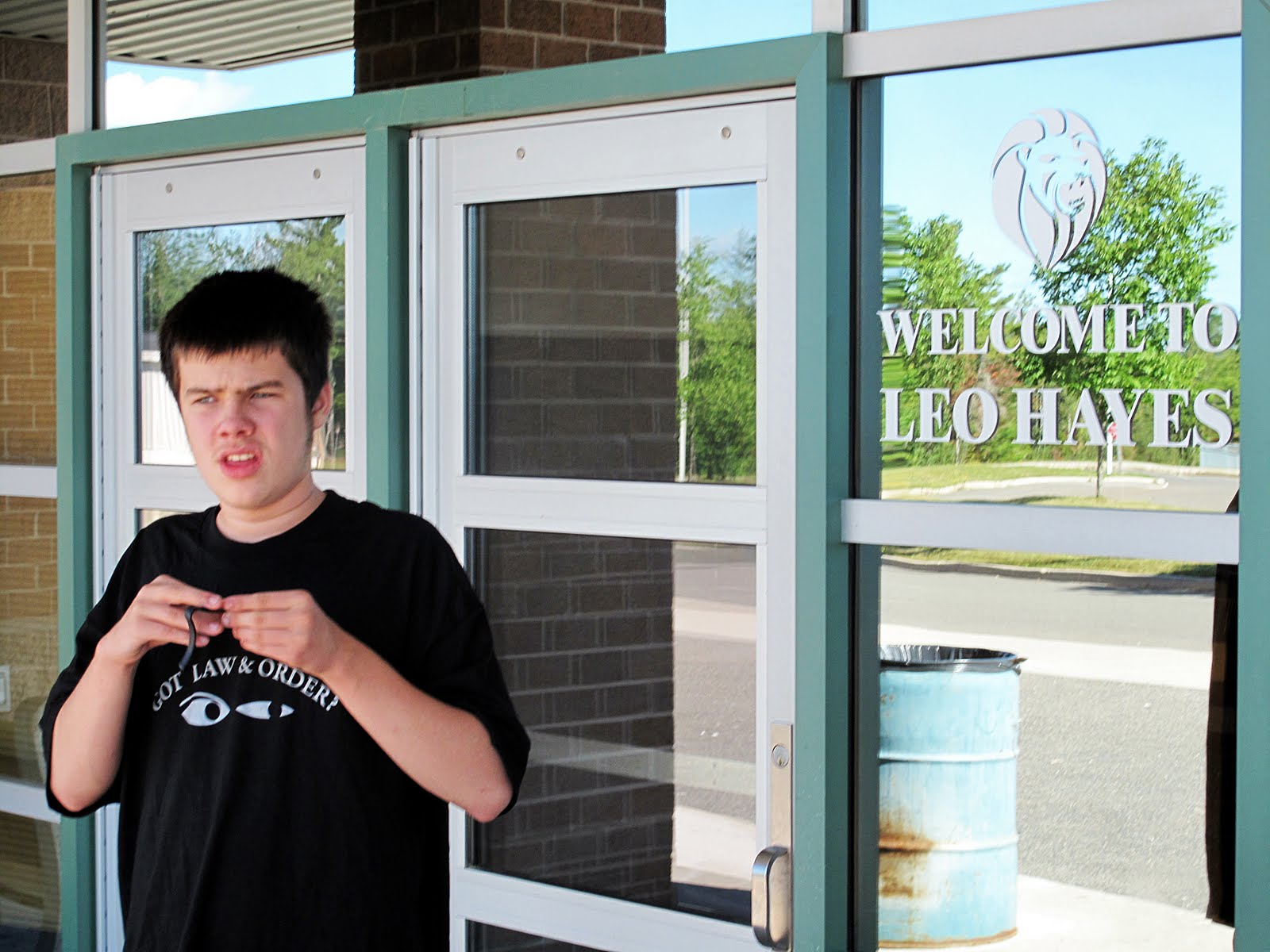
Conor has been anxious to return to school; literally counting down each day and telling Mom and Dad how many days left until school. Today was ONE DAY left!.  Last year we did some transition planning for Conor's move from Middle School to High School.  Together with Middle School, High School and District 18 representatives we prepared Conor, as best we could, for the transition to High School.  The planning included actual visits to Leo Hayes High School and work with the UNB-CEL Autism Intervention trained  Teacher Assistants who will be working with Conor this year. They also visited Conor at Middle School and spent some time working with him there before the end of the year.  Hopefully that familiarity with the place, and with some key people, will help ensure a smooth transition. Today, with more fine weather, I took Conor for a visit to Leo Hayes High School just to see the building, one more time,  where he will be attending school tomorrow.  

Saturday, June 26, 2010

Conor's Last Day at Nashwaaksis Middle School

Conor and Mom wore their finest Shrek Green T shirts as Conor headed off for his last day at Nashwaaksis Middle School.  Middle school has been a great time for Conor.  He loves going to school and he was a bit anxious yesterday knowing it was his last day. 

In the final picture Conor poses with Brad Daniels,  the Education Assistant who has worked with Conor for most of the past three years.  Brad has been absolutely outstanding working with Conor. I really can't put enough emphasis on what a great contribution he has made to Conor's life as  Conor began his journey through the physical and emotional challenges of adolescence (you can see by these and many pictures that Conor has had a significant growth spurt).  Brad has excellent training from the UNB-CEL Autism Intervention Training program and experience working with other autistic students but beyond that background his outstanding commitment and character are not easily matched.

There have been other fine Education Assistants working with Conor during Brad's breaks or when Brad was not able to attend at the school over the past three years. And he liked the staff as well. I don't even know the names of all the people that have treated Conor so well at Nashwaaksis Middle School (I will mention "Cathy" and "Mrs. Heptich"), including the many students who said hello to him and talked to him when he arrived at school.

To the fine people of Nashwaaksis Middle School a final thank you. Our buddy Conor has loved his time with you.


Tuesday, June 08, 2010

Conor Prepares for High School

[ConorBackYardAward.JPG]
Transition, Planning, Implementation.

Transitions are very difficult for many with autism.  Conor,  who has Autistic Disorder and intellectual disabilities, is now in his last year of middle school and will be moving next year from Nashwaaksis Middle School to Leo Hayes High School.  The planning for that transition began in the new year when we met with a planning  team from the middle school, high school and School District 18.  A good solid  transition plan was worked out and ... equally importantly ... implementation is proceeding as planned.
 
The essence of the transition planning is to famliiarize Conor with the new school itself and the people who will be working with him in small bites while he is still attending his regular middle school. The teacher assistants who will be involved with Conor next year have visited him and begun working with him part days at his current school.  He knows their names, he knows them. They are now part of Conor's picture. Conor has also spent part days at the high school he will be attending next year becoming familiar with the setting in which he will be educated next year. 

Yesterday was  a very good day for Conor.  He spent a full day at Leo Hayes High School working with the teacher assistants in the actual location in which he will be educated next year. Conor's excellent current teacher assistant Brad, who has been involved with Conor for most of his three years at middle school attended with Conor but removed himself from the scene, faded out of the picture, at various times during the day.  Conor did very well and  is scheduled to attend at Leo Hayes High School again this Wednesday for another full day. Hopefully it will go well as it did yesterday.

We had worried about Conor's transition from grade school to middle school but Conor loved it.  In the picture above he is shown posing with his perfect attendance certificate he received after completing his first year at Middle School.   When we moved to our current home 4 years ago we prepared Conor by driving by and pointing out our "new house" to him.  A friend, who is also an educator and Autism Clinical Supervisor, who has previously worked with Conor,  prepared some story boards with pictures of the "new house" on it and the transition was a huge success. So we know Conor  can handle transitions when properly planned for and implemented.

Conor's transition to high school has already begun and, while taking it one day at a time, we are very optimistic that it will work out well for Conor. When  he starts high school next year it will be in a place, and with people, that are already part of Conor's picture.

Thursday, June 03, 2010

Autism Is A Learning Preference Not a Disability? Educationalist Needs Some Reality Based Autism Education

Go to homepage.


educationalist


Main Entry: ed·u·ca·tion·ist 
Pronunciation: \ˌe-jə-ˈkā-sh(ə-)nist\
Variant(s): also ed·u·ca·tion·al·ist  \-shnə-list, -shə-nəl-ist\
Function: noun
Date: 1829
1 chiefly British : a professional educator
2 : an educational theorist

preference

Main Entry: pref·er·ence 
Pronunciation: \ˈpre-fərn(t)s, ˈpre-f(ə-)rən(t)s\
Function: noun
Etymology: Middle English preferraunce, from Middle French preferance,from Medieval Latin praeferentia, from Latin praeferent-, praeferens,present participle of praeferre
Date: 15th century
1 a : the act of preferring : the state of being preferred b : the power or opportunity of choosing
2 : one that is preferred
3 : the act, fact, or principle of giving advantages to some over others


According to the Miriam Webster online dictionary an educationalist is a professional educator or an educational theorist.  In the above reference  which also formed the headline  of the article in question and is now on the internet the Educationalist distorts the realities of Autism Disorders.  A preference, as set out in the MW involves a choice, the power to choose. Even for those with High Functioning Autism or Aspergers I have never seen a scholarly article or even a Neurodiversity ideological tract which describes their methods of learning as being choices.

The educationalist says  that autism is not a disability? Tell that to those with Autistic Disorder and intellectual disability. For them, including my son, autism is a serious disability.  The Educationalist should educate himself about autism DISORDERS before telling the world that autism is not a disability.

Educationalist educate thyself!

Tuesday, September 08, 2009

Zero Days to School and Conor is Happy

Knowing how anxious he would be to get to school today we had Conor's school bags and sports equipment packed and ready to go this morning. And Conor was happy to be going back to middle school. In the bottom picture Conor and Mom head off to the Nashwaaksis Middle School. Conor is the "slightly" taller one on the left.


Bookmark and Share

Sunday, September 06, 2009

ABA and Autism's Biggest Myth - Conor Counts the Days to Middle School


Conor has been counting down the days to school much of which is based on ABA (Applied Behavior Analysis) instruction in a room alone with an ABA trained (UNB-CEL Autism Intervention Training) Education Assistant. Conor loves school, including his ABA, as I have written about several times.

Today at about 6:30 am Conor came and got Dad to tell me "2 more days to Middle School". He has been asking about (Nashwaaksis) Middle School for the past few weeks. Some mornings he gets up and grabs his school lunch bag off the top of the fridge (top picture, above) telling us clearly that he wants to get back to school. He has also been joking about school, making comments about Conor going to Nashwaaksis Memorial where he attended grade school. When we agree he laughs and says "Noooooooo Memorial ... MIDDDDDLE School!".

The bottom picture, above, is a re-post of a perfect attendance record from his first year at Nashwaaksis Middle School, 2 years ago. Last year Conor missed a couple of days because of flu and because of a dental operation so he didn't get the perfect attendance certificate but he still came pretty close.

Those who allege that ABA turns children robotic, or is otherwise abusive, are creating a myth, Autism's Biggest Myth. They have no evidence, no studies, on which to base this myth. It is just the opinion of people with very little real exposure to ABA. Conor has loved the ABA instruction he has received. Because of the determined Autism Advocacy of some dedicated parents here in New Brunswick and a government that listened, both to parents and to the decades of research supporting the efficacy of ABA as an autism intervention, Conor has been able to receive ABA based instruction in school for the past several years ... and he loves every minute of it.

To Michelle Dawson and other spreaders of Autism's Biggest Myth ... you are wrong .... and you have nothing to back up your prejudiced opinions about ABA. Your opinion about ABA effectiveness is rebutted by hundreds of studies and dozens of credible professional reviews. Your myth about ABA abuse of autistic children is rebutted by .... Conor's very expert, very well informed, opinion.

NOTE: Even as I am writing this comment Conor came in to the kitchen from the back step where he is playing with water balloons to say "Middle School Breakfast" to his mother. He wasn't telling her he wanted breakfast ... he was telling her what was on his mind ... getting back to school.


Bookmark and Share

Sunday, June 07, 2009

Autistic Disorder and School Inclusion for Conor

In New Brunswick proponents of an extreme version of mainstream classroom inclusion have dominated our education system for the past 30 years. The mainstream classroom inclusion for all approach is based on an inflexible and erroneous belief that all children, regardless of their personal condition, regardless of whether they have serious learning disabilities or neurological disorders, benefit from total mainstream classroom inclusion. Change has happened over the last 5-6 years as some autistic children, including my son Conor, have been permitted to learn in an area more suitable for them personally but still be included in a neighborhood school.

On Friday I met with Conor's resource team at Nashwaaksis Middle School to review the past year and plan for next year. It has been a terrific year for Conor on many fronts. He does receive his primary instruction including ABA in a small room with an autism trained (UNB-CEL Autism Intervention Training Program) teacher assistant. But he also visits common areas of the school such as the library, the lunch room, the gym and the pool. He is recognized by other students some of whom have approached him on several occasions to say hello as he arrives at school with Mom or Dad.

On the side bar of this blog site are video clips from last year and this year showing Conor in the gym doing activities with the teacher assistant Brad Daniels. There are many other kids in the gym (I took care not to record the other children) but you can hear them in some of the videos. In these clips Conor is still not involved directly with the other students but he is around them.

Friday one of the resource team members who has been at the pool with Conor mentioned that he joins with the other kids in the pool on occasion. Conor will get up on one of the water rafts with the other kids pulling it around the shallow end, an activity we also do with him when we visit the pool. (She also gave me a snapshot she took of Conor preparing to leave the diving board, above)

Real school inclusion should be flexible as it has been for Conor the past few years. If an autistic child needs a quieter setting in which to learn, for ABA instruction, to avoid over stimulation, then they should be educated in a setting that accommodates that need. This does not mean that the child has to be isolated all day. The hallways and common areas can still be visited for identified purposes within the abilities of that child at that time. And the visits should be observed carefully to make sure the child is not overstressed.

For Conor a flexible approach to school inclusion, not mainstream classroom inclusion, has been very successful and beneficial for him.


Bookmark and Share

Friday, February 20, 2009

Conor In The Gym at Nashwaaksis Middle School


Yesterday was Conor's birthday.

It was also a day Dad visited the school gym to see Conor having some fun. Education Aide Brad Daniels does excellent work with Conor, in the study room, and in the gym. In these two videos Conor is shooting baskets and shooting on the net with Brad as the goalie.

If you play these videos you will hear a very loud echo and lots of childrens' voices. Conor can be upset by sounds but he has adjusted very well to the echos and noises in the gym. I recorded these videos in short clips with care to avoid recording any other children but there were many other students running by and playing various sports in the large fieldhouse gym.

I could see Conor paying attention to the activities of the other children and asked Brad about Conor's interest in them. Brad also informed me that the other kids show interest in Conor and ask him to join them on occasion. In addition to the gym where Conor goes daily he gets to swim in the school's Olympic size swimming pool twice a week.

Conor is very fortunate to attend Nashwaaksis Middle School in Fredericton. It has outstanding physical ... and human resources.


Bookmark and Share

Sunday, January 04, 2009

Autism Rising in Marin County


From coast to coast, across North America, autism is rising. In the United States, from South Carolina facing the Atlantic Ocean to Marin County, California, facing the Pacific, autism is rising and schools are struggling to meet the challenge of educating autistic children.

In Tsunami' of autism cases crippling to Marin parents, schools Rob Porter of marinij.com (Marin Independent Journal) reports on the struggles of parents and schools in Marin County, California, trying to provide an education to autistic school children whose numbers in Marin County have doubled from 76 in 2001 to 152 in 2008. The article is balanced quoting sources who explain the dramatic increases in autism diagnoses on the basis of the 1994 DSM changes which lumped Aspgergers Disorder together with Autistic Disorder but also quotes Robert Herndon, executive director of the Medical Investigation of Neurodevelopmental Disorders (MIND) Institute at the University of California at Davis who doesn't buy the belief that the DSM changes are a complete answer and points out that we really don't know at thist time what is behind the increases:

"The reason it's such a controversial question is that if we say autism is primarily a genetic disease, then we shouldn't be getting more of it. Genes don't just change - something in the environment has to interact with them. Some people don't want to think there is anything bad in the environment, while some want to say the environment is terribly toxic and that explains it. The truth is that we really don't know about any of them. There is no smoking gun. "

The truth is also that research into possible environmental causes of autism has been discouraged until fairly recently. That has been changing though and in 2007 the University of Minnesota aptly described a new paradigm for autism research, an autism research paradigm shift based on the possible interaction of genetic and environmental factors:

Autism research is poised for another paradigm shift, from an irreversible condition to a treatable disease. In the revolutionary paradigm, autism is not a rare disorder with a constant rate but frequent condition with a rising incidence. It is a combination of environmental influence and genetic vulnerabilities. It is both preventable and treatable, not by any one method but by a combination of behavioral and biomedical approaches. Autistic kids are not defective, they are sick but otherwise normal kids, and thus, recoverable.


Bookmark and Share