Showing posts with label ASAT. Show all posts

Sunday, April 19, 2015

Nice To See Autistic Twin Sons of Toronto Family Receiving Autism Treatment In New Brunswick


PHOTO BY MARC GRANDMAISON / THE CANADIAN PRESS

The headline of the Toronto Star article Toronto family chases autism treatment across the country  doesn't mention the province to which the family in the Toronto Star article seeking early autism treatment for their autistic twin sons moved  - New Brunswick. Nor does the article itself delve into how the province usually mentioned as a financial disaster could have become a Canadian leader in early autism treatment as it was described by David Celiberti, Ph.D., BCBA-D, President of  the Association for Science in Autism Treatment in an October 23, 2010 commentary "ASAT Responds to Canadian CBC's N.B. Can Be a Leader in Autism Services" and again in his  interview with Dr. Paul McDonnell in the 2014 ASAT summer newsletter.  The essence of the Association of Science in Autism Treatment's commentary was that NB was already a leader; one whose autism service model was worthy of consideration by other Canadian jurisdictions. 

So how ... and why .... did New Brunswick develop an early intervention model worthy of consideration by other Canadian provinces seeking to provide early autism treatment to the autistic children of their province?  Without going over it again in detail intense parent advocacy focused specifically on request for  an early autism intervention prompted the NB government of day to to put out tenders for agencies to provide early autism treatment.  That call was answered successfully by Paul McDonnell and UNB-CEL. who developed the UNB-CEL autism training program in both French and English.

We have previously heard unconfirmed rumors of families in national organizations seeking relocation to NB so their autistic children could receive treatment. It felt good for this autism parent who was part of that very focused, committed parent advocacy team that prompted development of the made in NB autism program  to see the be benefits of the program being received by the children of the Toronto family in the Toronto Star article. 

Friday, March 06, 2015

THANK YOU Conservative MLA Jake Stewart and NDP Leader Dominic Cardy For Speaking Up In Support Of Adult Autism Care and Treatment in New Brunswick


New Brunswick governments have been outstanding in establishing an internationally recognized early evidence based autism intervention service and have made some gains in autism training for Education Aides and Resource Teachers.  

There has been no progress though  in establishing an autism centre for adult treatment and permanent residential care for severely impacted autistic adults with a network of autism group homes around the province.

It is very easy to become discouraged in advocating for adult autism care in New Brunswick.  The establishment of early evidence based autism intervention services was not easy but successes have been achieved.  While there have been backward steps such as the recent hard line 95% attendance requirement, since revised, which did not appear to take into pressures and demands on family and the time available to them the NB early intervention program has been recognized as a leading Canadian model by the Association for Science in Autism Treatment.  Some gains have also been made in provision of autism trained Education Aides and Resource Teachers although much more needs to be done including training more aides and teachers and ensuring that autism trained aides work with autistic students and not be displaced by untrained aides with more seniority.  Adult autism residential care and treatment however  remains abysmal and the first signs indicate that things are not likely to change under the current Liberal government. The NDP and Green Party both addressed adult autism care issues during the last provincial election.  Both the Liberal and Conservative parties were silent on autism issues.    

The adult autism care problem, as reported by Samantha Magee and the Miramichi Leader, has flared up again recently in Miramichi when a 19 year old non verbal autistic man was given notice of eviction from the special care home in which he resided solely because he was now an adult. Several persons including me spoke out yet again asking our government to address the adult autism care issue in New Brunswick.  Specifically we asked the government yet again to build an autism treatment centre in Fredericton near the expertise of the Stan Cassidy Centre which treats autistic children and youths and provide permanent residential care for those with severe dysfunctional autism disorder. The centre would also provide oversight and training for autism group homes in New Brunswick communities around the province.

The Miramichi Leader reported  former Autism Society New Brunswick President Lila Barry's comments urging the establishment of the autism centre based network as described by UNB Professor Emeritus (Pscychology) Paul McDonnell in 2010 and asked the Minsiter of Social Development for a response.   The government response came from Communications Officer Anne Bull:

"When asked if the minister of Social Development has looked into the possibility of building such a facility that could offer diagnosis, treatment and long-term living arrangements, the Miramichi Leader received the following response from communications officer Anne Bull.

“The Government of New Brunswick recognizes the need to provide high quality services that support our province’s families and individuals living with autism. As a government, we are committed to continuing to improve services to families and individuals living with autism. This includes examining the issues around living accommodations and supports for those with high care needs who require services beyond what is presently available. Government continues to make significant investments in services to adults with disabilities. Social Development works in collaboration with the New Brunswick Disability Executive Network and other key stakeholders to recommend on-going improvements to the Disability Support Program, finding innovative ways to support adults with disabilities and their families with the unique challenges they face.”

Communications Officer Bull did not provide a direct answer to the questions of whether the Minister of Social Development had even looked into the possibility of building the facility that could offer diagnosis, treatment and long-term living arrangements. Requests for such a centre have been made for years and it is easy to become discouraged when our government officials refuse to provide a direct answer to such an important question and instead pass the buck to a communication officer to provide a formulaic, meaningless answer.

A bright side to the recent events has been the support of Conservative MLA Jake Stewart and NDP Party Leader Dominic Cardy.  Mr Stewart was also quoted by the Miramichi Leader's Samantha Magee:


"Jake Stewart, Progressive Conservative MLA for Southwest Miramichi, agreed that the system was failing the Keenans and other families like them in similar situations. “Adequate facilities are needed in New Brunswick to alleviate strain on families found in this situation, and on individuals like Brandon who clearly deserves better. Also, a change in policy in Social Development is most likely needed,” said Stewart in an email to the Miramichi Leader. “‎I’m offering my support in the construction of new facilities, a potential change in policy, and of course I can and will continue to be a voice of reason for the Keenan family,” said the MLA. “But first, it’s important to allow Brandon to stay at M.O.R.E. Services from now on without worry of being displaced due to his age. If another facility can accommodate, this too may be beneficial. Time is of the essence.”"

NDP party leader Domonic Cardy responded to the recent events in Miramichi with a Facebook commentary:

Adults with autism get a raw deal in New Brunswick - often shipped off to a facility in Maine. During the election the NDP committed to build a residential facility here in New Brunswick where adults with autism who need the care can get it, 24/7. The Liberal government has been supportive of this idea but, as you can see from the story below, we need to move faster.
This is why we have to rein in wasteful spending: so we have the resources to look after the folks who need our help.
As the parent of a severely autistic 19 year old son who lives at home and requires 24/7 care I know that many parents face daunting challenges caring for their autistic children and find it difficult to continue to provide that care, while earning a living and still find the energy, time and willpower to continue to advocate in the face of government and bureaucratic inertia and indifference  for humane, professional adult autism care and treatment but ... we have no other choice; we have to do our best to remain strong and to remain optimistic and to continue the fight.  
In the meantime THANK YOU Jake Stewart and Dominic Cardy for your support and THANK YOU Samantha Magee and the Miramichi Leader for your attention and outstanding journalism on adult autism care and treatment issues.  

Thursday, February 02, 2012

ABA Benefits for Autism: Association for Science in Autism Treatment (ASAT) Educates LA Times Alan Zarembo


The attached letter was written by ASAT Board member Sabrina Freeman Ph. D., and Secretary Florence DiGennaro Reed, Ph. D., BCBA-D to the LA Times Alan Zarembo who did such a poor job (in my humble opinion) reporting on autism issues in a recent LA Times series.  In the letter Freeman and Reed attempt to educate Zarembo about the scientific, evidence based benefits that ABA has been demonstrated to bring to autistic children.  

I don't know if a superficial mainstream media reporter is capable of  understanding the information presented in the letter or if he would make the effort to understand.  I applaud ASAT for trying to break through Zarembo's self constructed brick wall of ignorance and educate him about the evidence basis behind ABA, an intervention that has helped so many autistic children. 

ASAT Responds to LA Times Story “Families Cling to Hope of Autism Recovery”


Monday, January 30, 2012

Dear Mr. Zarembo:

We are writing to you regarding your article entitled, “Families Cling to Hope of Autism Recovery” (the Los Angeles Times, December 15, 2011). We appreciate your time and effort in highlighting the work of Dr. Lovaas and the larger field of applied behavior analysis. We especially appreciate your advocacy of science as the means to evaluate the effectiveness of any treatment.

While you acknowledge some positive benefits of applied behavior analytic treatment, your emphasis ignores a large body of research indicating that children who receive Early Intensive Behavioral Intervention (EIBI) benefit significantly relative to those children who do not receive EIBI. We ourselves acknowledge that there are gaps in the science of autism treatment, including EIBI; however, we respectfully disagree with your presentation of the outcomes. We are unaware of other treatment protocols that have been studied and replicated to the same degree as EIBI. Unfortunately, many other treatments are marketed as “cures” without evidence of benefit. As such, EIBI represents best practices for people with autism. While you rely on the AHRQ report in your article, we wish you had also highlighted that treatments based on the principles of applied behavior analysis have been endorsed by the U.S. Surgeon General,1 National Institutes of Health,2 the National Research Council,3 the National Standards Report4 published by the National Autism Center, and others. 5Although we agree that additional research is needed to develop and refine EIBI and other science-based approaches, your article leads readers to conclude that the high cost and burden of a forty hour-a-week requirement to replicate the positive outcomes from the scientific literature is too high a cost for society. We advocate for research funding to identify aspects of treatment that are most important for improving function. Until that time, though, children with autism deserve access to high quality treatments based on our current understanding of science.

The science of applied behavior analysis and its application to autism treatment are often portrayed inaccurately in the media. Unfortunately, we believe your story contributes to further misunderstanding and misconception. The potential risk is that caregivers will delay pursuing empirically-supported, effective treatment. We suggest that rather than advocate denial of effective autism treatment, we should acknowledge the true state of science in autism intervention and advocate for access to effective treatment by families. It is important for parents and caregivers to access accurate information regarding autism treatments so that they may make wise decisions for their children. For more information, please visit http://www.asatonline.org/resources/autismtreatments.htm.


Sabrina Freeman, Ph.D.
Board Member, Association for Science in Autism Treatment


Florence D. DiGennaro Reed, Ph.D., BCBA-D
Secretary, Association for Science in Autism Treatment


References 
1U.S. Department of Health and Human Services (1999). Mental health: A report of the surgeon general. Rockville, MD: U.S. Department of Health and Human Services, Substance Abuse and Mental Health Services Administration, Center for Mental Health Services, National Institutes of Health, National Institute of Mental Health.
2
Strock, M. (2004). Autism spectrum disorders (pervasive developmental disorders). NIH Publication No. NIH-04-5511. National Institute of Mental Health, National Institutes of Health, U.S. Department of Health and Human Services, Bethesda, MD, 40 pp. http://www.nimh.nih.gov/publicat/autism.cfm
3
National Research Council (2001). Educating children with autism. Committee on Educational Interventions for Children with Autism, Division of Behavioral and Social Sciences and Education. Washington, D.C.: National Academy Press.
4
National Autism Center (2009). National Standards Report. Randolph, MA: National Autism Center.
5
New York State Department of Health (1999). Clinical practice guideline: Report of the recommendations. Autism/pervasive developmental disorders, assessment and intervention for young children (age 0-3 years). Albany, NY: NYS Early Intervention Program.

Monday, November 07, 2011

ASAT President David Celiberti's Fredericton Presentation on Evidence Based Autism Treatments


L: Harold Doherty              R: David Celiberti 

I was privileged yesterday to be able to attend a presentation by  autism expert David Celiberti Ph.D., BCBA-D, President of the Association for Science in Autism Treatment.  David Celiberti is an advocate for evidence based treatment for autism disorders. He also works directly with autistic children in two states, Maine and New Jersey.  Here in New Brunswick, Canada we have been fortunate to have enjoyed his contributions to the development of the UNB-CEL Autism Intervention Training program on several occasions.  

Yesterday, a day ahead of a two day workshop he is presenting with the UNB-CEL AIT program, Celiberti took time to speak about evidence based autism treatments to interested parents and professionals at the Autism Connections Center here in Fredericton.  It was a beautiful, fall day but it was well worth spending part of the afternoon to learn more about understanding the importance of evidence based treatment of autism disorders, and learning from David Celiberti's academic, professional and clinical experience in the application of evidence based, ABA treatment for children with autism disorders. A very comprehensive list of credible authorities that have reviewed the evidence basis of autism treatments was presented along with some suggestions on how to evaluate specific autism treatment programs and service providers. 

Anyone with an interest in understanding the evidence basis of the hundreds of purported autism treatments could begin by visiting the Association for Science in Autism Treatment website and subscribing to the ASAT Newsletter. Another edition of the ASAT newsletter is expected to be issued today. 

Thursday, February 10, 2011

Autism Interventions: New York Times, Once Again, Pushes Non Evidence Based Floortime And Ignores Evidence Based ABA

The New York Times is at it again ... pushing Floortime as an autism intervention ... without mentioning the lack of scientific, empirical evidence in support of its effectiveness. In A Child Psychiatrist Talks About Autism the NYT features a column by Dr. Joshua D. Sparrow which promotes Floortime as an intervention for autistic children and encourages parents of autistic children to consider Floortime as an intervention for their children. (And of course, as usual with the NYT there is no mention of the solid base of evidence in support of ABA as an autism intervention):

"One promising treatment for such children is Floortime, a developmental, individualized and relational approach.


After a careful assessment of the child’s unique profile, therapists and parents using the Floortime approach work together to help the child learn to handle sensory stimulation while gradually interacting in more complex and rewarding ways. The goal is to help these children engage in meaningful relationships, expanding their capacity for communication, understanding and complex, abstract thought. One of the keys is to find the child’s motivation, and to use it as fuel for this work. Another is to make the work rewarding by making it fun and pleasurable for child, parent and therapist. But it is hard and time-consuming work, and families of children with autism spectrum disorders deserve all the support we can possibly give them. Experience has shown that children with autism who are given the support they need are able to expand their abilities to relate, to learn and to communicate, especially with their loved ones.


...


For more on autism spectrum disorders and Floortime, see the International Council on Learning and Developmental Disorders Web site.


Among the many helpful and hopeful books on autism spectrum disorders are those by the late child psychiatrist Stanley Greenspan and the psychologist Serena Weider, including “Engaging Autism: Using the Floortime Approach to Help Children Relate, Communicate and Think,” and a new one to be published in April by the pediatrician Ricki Robinson, called “Autism Solutions: How to Create a Healthy and Meaningful Life for Your Child.”

The NYT presents this latest Floortime promotional vehicle without mentioning the limited evidence in support of its effectiveness as reviewed by the AAP and the Association for Science in Autism Treatment.


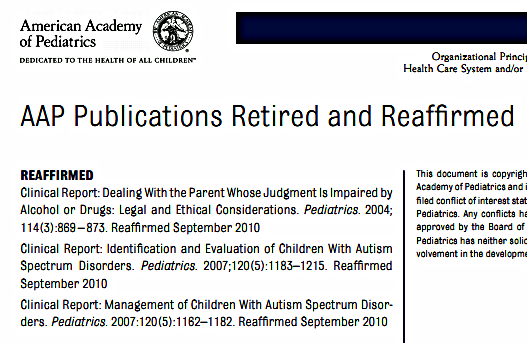
The picture above is from the AAP Publications Retired and Reaffirmed policy page and indicates that in September 2010 the American Academy of Pediatrics Reaffirmed the Clinical Report: Management of Children with Autism Spectrum Disorders. Pediatrics 2007. The 2007 Report described the lack of empirical, scientifc evidence in support of the efficacy of DIR/Floortime as an intervention for autism spectrum disorders:

"The DIR approach focuses on (1) “floor-time” play sessions and other strategies that are purported to enhance relationships and emotional and social interactions to facilitate emotional and cognitive growth and development and (2) therapies to remediate “biologically based processing capacities,” such as auditory processing and language, motor planning and sequencing, sensory modulation, and visual-spatial processing. Published evidence of the efficacy of the DIR model is limited to an unblinded review of case records (with significant methodologic flaws, including inadequate documentation of the intervention, comparison to a suboptimal control group, and lack of documentation of treatment integrity and how outcomes were assessed by informal procedures55 ) and a descriptive follow-up study of a small subset (8%) of the original group of patients.59" 
(page 1165)

The following information is currently found on the ASAT web site and indicates that Floortime is plausible but essentially untested.

Association for Science in Autism Treatment


Developmentally-based Individual-difference Relationship-based intervention (DIR)/Floor Time


...

Research Summary: DIR is widely considered to be a plausible intervention approach (i.e., one that could be effective), but it has not been evaluated in peer-reviewed studies with strong experimental designs (National Research Council, 2001). An uncontrolled study reported favorable outcomes (Solomon et al., 2007).

Recommendations: An important area for future research is to evaluate DIR in studies with strong experimental designs. Professionals should present DIR as untested and encourage families who are considering this intervention to evaluate it carefully.

It isn't clear to me why the NYT pushes Floortime, a non evidence based autism intevention, and ignores ABA,  the most evidence based intervention for autism, as reviewed for several decades by authorities from the US Surgeon General, to state agencies in Maine, New York and California to the Association for Science in Autism Treatment to the American Academy of Pediatrics. I have to assume that the personal biases and prejudices of senior health editors at the New York Times lie behind this persistent attempt to promote non evidence based autism interventions and ignore or put a negative spin on ABA.  I can think of no other reason, rational or not, for the NYT's  misguided autism intervention reporting.

Saturday, November 27, 2010

Science in Autism Treatment Newsletter


The following E-blast, which I am happy to post here at Facing Autism in New Brunswick,  is from Josh Pritchard of the Association for Science in Autism Treatment:

Hello All!

We have all witnessed consumers enticed and distracted by the myriad of alternative treatments that have been put forth. Often, these treatments run counter to effective approaches and may deplete precious resources.  We believe that ASAT’s free e-newsletter may help. Newsletter recipients will stay informed of up-to-date science-based treatments, read about ASAT’s response to inaccuracies about autism treatment in the media, and learn how science can be used to inform decision making. 

If you’re at your computer and have a few moments, now might be a perfect time to sign up for the Association for Science in Autism Treatment’s free quarterly newsletter, Science in Autism Treatment.  You can sign up here: www.asatonline.org/signup

We have a new issue coming out soon – signup so that you’ll receive it first!
Our goal was to get our newsletter out to 6000 subscribers by the end of 2010.  We’re quickly reaching the end of 2010 – and only need a few more subscribers! Will you help us reach it?

If you’re unfamiliar with SIAT, it is a newsletter packed with information (20-30 pages per issue) that include things such as:

·       Is there science in that? [we take treatments proposed for autism and examine the scientific literature supporting it]

·      Consumer Corner [we feature a resource of interest to consumers]
·        
T Treatment  Summary [we choose a treatment proposed for autism and provide a very brief summary]

·       Clinical Corner [we have a clinician answer a specific question related to autism treatment]

·       Interview with those in the field [we interview a ASAT board members/volunteers, parents, and scientists in the field]  

·       Article reviews [generally 3 article reviews that provide a quick and easy review of articles germane to scientific treatment in autism]
·        
Upcoming Events that may be of interest to the reader

·       Book Reviews…
…and much more

Please also see http://asatonline.org/pdf/newsletter_ad.pdf If you are already signed up – we urge you to share this invitation with others that you think might be interested.  

We hope you are having a great holiday weekend!

Yours in Science,

Josh Pritchard
Co-Editor of SIAT

Thursday, October 28, 2010

Association for Science in Autism Treatment: New Brunswick (Canada) is Already a Leader in Autism Treatment

During the recent election campaign CBC published on its web site an article by New Brunswick autism expert Dr. Paul McDonnell. The CBC headline read “N.B. Can Be a Leader in Autism Services" and the article appeared on September 14 2010.   David Celiberti BCBA-D, President Association for Science in Autism Treatment, commented on that article pointing out that New Brunswick is already a leader in autism services. Dr. Celiberti is very familiar with New Brunswick's autism service delivery, having spoken in Fredericton and having met with parents, autism advocates and autism professionals here.  His comments on the CBC article can be found on the ASAT website under the title ASAT Responds to Canadian CBC's "N.B. Can Be a Leader in Autism Services" and are set out following this introduction. (The bold blue emphasis is added by me - HLD)
ASAT's recognition and encouragement to continue in our efforts here in New Brunswick are most welcome.

"ASAT Responds to Canadian CBC's "N.B. Can Be a Leader in Autism Services"

Saturday, October 23, 2010

I read with great interest your recent article about the state of services in New Brunswick (“N.B. Can Be a Leader in Autism Services," September 14, 2010). I do beg to differ about the title of the piece. New Brunswick is already a leader. To have amassed 800 trained agents of change in six years is nothing short of incredible and inspiring, particularly given the diversity of your province with respect to geography and language. Other Canadian provinces can look to New Brunswick for an exemplary model of how things could and should be for children with autism and their families.

There is a misconception that services in the United States are superior to that of our neighbors to the north. I can assure you that children with autism in rural areas and in economically depressed areas of the U.S. do not always access state of the art, science-based treatment such as those based on applied behavior analysis. In many cases throughout the US, children with autism receive poor quality behavior analytic services that may be lessened if providers were able to access more intensive training and networking opportunities similar to what is being offered in your province. Part of the Association for Science in Autism Treatment (ASAT)'s mission is to help close that gap through information dissemination, and we are keenly interested in the efforts of leaders like yourself developing, implementing, and evaluating systems.

And like other true leaders, you have looked critically at your accomplishments with an eye toward making every year of service delivery better than the previous year. We applaud your recognition that treatment parameters such as intensity need to be tailored to each child to maximize gains. When resources are scarce, this individualization can be an arduous task, but nonetheless critically important. Equally important is the need to communicate to government officials, tax payers and other stakeholders that immense financial savings are attached to doing right by our children when they are young.

It is unfortunate that funding for parent training is not more abundant. Optimal outcomes for children with autism are predicated on the support of educated, informed and skillful parents. Promoting carryover, ensuring consistency, and enhancing skill development across all environments are crucial roles for parents, but parents require support and training to assume these crucial roles. Your stated concerns and insights about the dearth of services for adults are much appreciated, and reflect the challenges that we have here in the U.S as well.

Families of children with autism in New Brunswick are blessed. Keep fighting the good fight.

David Celiberti, Ph.D., BCBA-D, President
Association for Science in Autism Treatment

Tuesday, August 24, 2010

Looking for Helpful Autism Information Online? Start With ASAT, the Association for Science in Autism Treatment

We all know that, at least when it comes to autism, the on line world is a mess. There is no such thing as a community of interests when discussing autism. There are many parents trying to make sense of what is happening with their child and his or her autism disorder. There are professionals trying to help , some with totally pure and noble intentions, others who don't give a flying fig about your autistic child who are  guided by self interest or personal ideology.  There are some obvious sites to be careful about when trying to find on line autism help ... the Scienceblog bloggers whose focus is in proving that vaccines can never, ever, ever cause autism or any form of neurological damage will be of no assistance to you at all and  the "scientists" and  "skeptics" who blog there have only a tangential interest in autism and know very little about autism disorders. 

The Neurodiversity bloggers who think that autism is not really a medical or mental disorder, who will try to convince you that autism is just a natural variation, a wonderful parade of joy and bliss, that autism can only be considered a disorder in the sense that autism is not accepted by society should absolutely not be taken seriously. They could well lull you into a false belief that all will be well if you just think good thoughts about autism which they have elevated into an object of worship.

With all the nonsense that clutters the autism world on line where can a parent seeking to help their autistic child look to ground themselves as they being the life long struggle, and it will be a life long struggle in most cases, to help their autistic child? My recommendation for a starting point in the search for information is not in the autism blogs, including this one, notwithstanding that it is arguably the best informed, best intentioned and best written autism blog in the world (just kidding people).  The site that I recommend as your starting point in your on line autism journey and a valuable resource at all times is the Association for Science in Autism Treatment. The ASAT logo states that if offers real science and real hope and if you are looking for real science and real hope I suggest you start at ASAT.

The ASAT site is dedicated to an evidence based approach to autism treatments. The ASAT organization  is thorough, balanced and well informed. It is guided  by people like David Celeberti and Bridget Taylor, people who are both well educated and very experienced in actually helping autistic children.  In reading the abundant materials on the ASAT site you might think it is essentially an ABA site but if you do then you are simply ... wrong.  ASAT, as the name indicates is committed to real science, evidence based science. For many years ABA has been the only autism intervention that has enjoyed any substantial body of  quality evidence in support of its effectiveness. If you read the ASAT comments and recommendations though you will find acknowledgments that other approaches hold some promise but require more research in to determine their effectiveness.  ASAT does state point blank, but without exaggeration, that some methods are implausible and possibly dangerous and identifies those methods.

Throughout the ASAT site you will find language that is respectful both towards parents and towards most efforts to help autistic children.  There is a lot of helpful information on the ASAT site, it is well researched and well organized.  If you are starting on the path of helping your newly diagnosed autistic child you should really consider starting with the Association for Science in Autism Treatment.

NOTE: This is not a paid infomercial and I do not  have advertising on this blog site. My only connection to ASAT , other than being a parent of a severely autistic son,  and having read ASAT materials for many years, is that, along with some other autism parent advocates,  I had the privilege of meeting  David Celiberti briefly during a visit he made to Fredericton.

Nor do I agree with everything on the site. The ASAT site prevalence information for Autism Spectrum Disorders,  perhaps reflecting the influence of  advisory board member Dr. Eric Fombonne,  still indicates a 1 in 160  rate well after the CDC stated that the current rate for ASD's  is 1 in 110. That said,  the place to start  looking on line for trustworthy, documented information about autism treatments is ASAT.  IMHO.

Tuesday, April 14, 2009

ASAT Association for Science in Autism Treatment Newsletter Returns

ASAT, the Association for Science in Autism Treatment, has announced the return of its newsletter, Science in Autism Treatment. The newsletter ran from 1999-2003 and will return this summer.

Back issues are still available for viewing at http://www.asatonline.org

This free quarterly newsletter will feature:

*Featured articles by leading advocates for science-based treatment
* Clinical Corner responses to frequently asked questions about autism treatment
* Detailed summaries of specific treatments for autism
* Book reviews
* Reviews of published research to help consumers and professionals access the science
* Interviews with professionals advancing science based treatment and confronting pseudoscience
* Discussion of accurate and inaccurate portrayals of autism and its treatment by the media
*Guidelines to help consumers access effective treatments

YOU can join the mailing list to receive the FREE newsletter by visiting the ASAT website at:


Bookmark and Share

Saturday, March 07, 2009

Michelle Dawson's False Claims Allegations? Where's the Evidence?

Jonathan Mitchell of Autism's Gadfly has run afoul, like so many others have, of Michelle Dawson.

On the discussion board Misbehaviour of Behaviourists Ms Dawson has accused Jonathan of making false statements about her. Apparently Jonathan made a statement about Ms Dawson's communications with the IACC, the Interagency Autism Coordinating Committee that might not have been correct; or at least not literally correct. Ms Dawson takes Jonathan to task over the issue at the Misbehaviour of Behaviourists. Then, out of left field, Ms Dawson also accuses me of making false claims about her as well:

Michelle Dawson 8995
03-06-2009 08:31 PM ET (US)

Edited by author 03-06-2009 08:32 PM

Still in the "pants-on-fire" dept., for what Mr Mitchell wrote on his blog, see /m8990. What Mr Mitchell has claimed on his blog is false. He made it up.

If Mr Mitchell did not make anything up, as he claims, then I'm sure he can provide sources to support his claim that I was "writing letters trying to influence the direction of NIMH autism research" and so was Mike S.

I suggest that as with Mr Doherty, no one should believe Mr Mitchell when he makes any claims about people he disagrees with, unless Mr Mitchell can provide sources (in this case, links to all the "letters" Mike S and I have written to the NIMH) to support his views.

Some day when I have a lot of spare time, I'll try to find and list all the false claims, misrepresentations, etc., made about me and my colleagues by Mr Mitchell and Mr Doherty.

As you can see Ms Dawson did not provide any specifics, particulars, examples, information or evidence of any kind whatsoever to substantiate her out of left field allegations against me. She just decreed that I have made false claims and informed her loyal subjects that some day, when she had the time, she would bother herself with substantiating her allegations. That my friends is the work of Michelle Dawson, autism researcher and anti-ABA activist.

To my knowledge the statements that I have consistently made about Ms Dawson are that:

1) She is an anti-ABA activist ( see the title of her forum (the Misbehaviour of Behaviourists), her appearances before the Supreme Court of Canada and the Canadian Senate in opposition to ABA for Canada's autistic children and her numerous media comments opposing ABA.)

2) That her anti-ABA views are inconsistent with the views of numerous credible authorities in the United States, like the US Surgeon General, the American Academy of Pediatrics, the MADSEC (Maine) Autism Task Force, the NY State Department of Health, and the Association for Science in Autism Treatment to name the most prominent.

I stand by these statements which are factually correct. And I caution anyone against putting too much weight on any of Michelle Dawson's allegations and statements that she has made against anyone, professional, reporter, parent or autistic person who dares to disagree with her views.


Bookmark and Share

Wednesday, December 12, 2007

Canada's Autism Disgrace


What is Canada's National Autism Strategy? The answer is simple; we don't have one. And as long as Stephen Harper's Reform-Alliance-Conservative government rules Canada with an iron fist we will not have a National Autism Strategy. My friends of Conservative background in Canada may not like it but that is the hard brutal truth. Canada will not have a real National Autism Strategy as long as Stephen Harper is Prime Minister of Canada.

We certainly had the beginnings of a National Autism Strategy with the passing of the Andy Scott-Peter Stoffer motion in the House of Commons. And MP Shawn Murphy fought the good fight with his private member's initiative; defeated in the House of Commons by the alliance between the Harper Conservatives and the separatist Bloc Quebecois. Senator Jim Munson has continued his valiant efforts to keep the need to address Canada's national autism crisis alive in the media but even those efforts are becoming more challenging as the Harper-Clement team simply ignores these initiatives, ignores the needs of autistic children and adults in Canada, and proves day in and day out that they don't give a damn about the fate of autistic Canadians.

The National Autism Strategy of Prime Minister Harper really amounted to nothing but a mediocre web site and a promise of a National Autism Symposium. The National Autism Symposium was postponed when it became clear that real autism advocates, parents fighting for their autistic children, wanted to attend the symposium. A second symposium was scheduled for November 8 and 9 in Toronto. The invitation process was itself secretive, parents were largely unrepresented and any outspoken advocates were intentionally excluded from the Symposium.

The lists of speakers and symposium themes were never made public. The list of Harper government, hand picked delegates, to the symposium was never made public although it is a good bet that anti-ABA activists like Michelle Dawson and Laurent Mottron would have been invited. The Quirks and Quarks duo rarely miss an opportunity to promote their fringe anti-ABA views, contrary to hundreds of studies over 5 decades and numerous reviews of those studies by organizations such as the US Office of the Surgeon General and the American Academy of Pediatrics, that ABA is a scientifically supported, evidence based, effective treatment for autism. Their long held, closed minded views, so at odds with mainstream professional opinion, come in handy when needed by a government seeking excuses to camouflage their do nothing approach to addressing Canada's National Crisis. Just a guess, but I am betting that the Harper team was quite happy to invite Mottron and Dawson to the invisible, forgotten, National Autism Symposium.

The Autism Symposium went ahead on November 8 and 9 in Toronto and Canadians STILL don't know a thing about what was said; or what conclusions, if any, were reached. It is likely though that the Harper spin doctors will ultimately issue a summary indicating that there is lack of agreement on issues on the effectiveness of any one intervention in treating autism. The results of hundreds of studies over five decades of research, the reviews by the American Academy of Pediatrics, the Office of the US Surgeon General, the MADSEC Administrators, the New York and California state agencies, the Association for Science in Autism Treatment; all will be ignored.

The views of a few fringe anti-ABA activists will be used to prop up a cynical do nothing Harper autism policy. And Canada's National Autism Strategy will remain as nothing more than what it now is - Canada's Autism Disgrace.